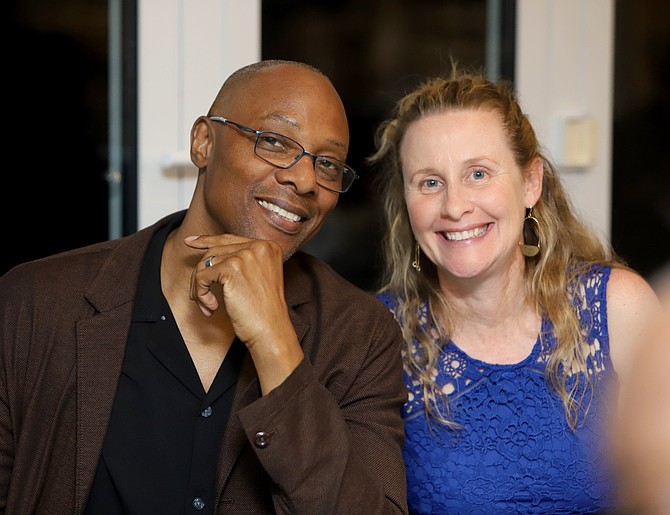
Troy Kemp (L) and wife Mary Kemp (R)
By BRENT STUBBS
Chief Sports Editor
bstubbs@tribunemedia.net
AS he reflected on the life of his late coach/mentor Neville Wisdom, Troy Kemp reminisced about his career and how he is not surprised that his Bahamian men’s national high jump record is still standing.
On July 12, 1995 in Nice, France, Kemp soared 7-feet, 9 3/4-inches or 2.38 metres to establish one of the longest standing records in the history of track and field in The Bahamas.
His mark follows the longest standing marks of the three minutes and 45.72 seconds that William 'Knucklehead' Johnson ran in the men's 1,500 metres on May 17, 1983, Bradley Cooper's discus heave of 220-1 (67.10m) on June 14, 1986 and Craig Hepburn's leap of 27-7 1/4 (8.41m) in the long jump on June 17, 1993.
Looking back at his tremendous achievement, Kemp said his only regret is that he didn't get the kind of national recognition that he felt he deserved.
He noted that while his image is on the Wall of Fame with the other Bahamian sporting legends in the Lynden Pindling International Airport, he couldn't understand why he's not on the Walk of Fame with the other superstars at the entrance of the Thomas A Robinson National Stadium.
"I've gotten multiple calls from people who are very upset that I'm not on the walk of fame," Kemp said.
"I even had some of my American friends who went to The Bahamas and they told me that they didn't see my portrait up there.
"My own daughter asked me that same question and I had to tell her that I couldn't answer it. It's embarrassing when I bring my family there and I'm not there. I don't know if I rubbed somebody the wrong way."
Unlike the Hall of Fame where athletes who have shined as international champions or medallists are displayed at the LPIA, the Walk of Fame includes past and present athletes who have excelled in their various disciplines.
But if Kemp is on the Wall of Fame, he should be on the Walk of Fame with all of the other athletes, who have all completed their illustrious sporting careers. So why is Kemp not included?
An injury to his ankle in Germany in 1995, after he won the world title, forced Kemp to contemplate retirement after his appearance at the Olympic Games in 1996 in Atlanta, Georgia. But his then manager encouraged him to continue and in 1997 he ruptured his tendon in his ankle and that eventually forced him to finally call it quits. He said he had some regrets when he walked away because he still felt he could have jumped higher, especially producing a 7-6 effort in his first meet after taking a year off in 1997.
But he's just honoured to still be recognised as the highest high jumper in the country with his 31-year-old record remaining in the almanacs of The Bahamas’ track and field history.
"I'm not surprised that the record is still there. Whoever breaks that record would probably be the best jumper in the world today," Kemp said.
"So there's no surprise that it's still there. Donald (Thomas) came close. He won a world title and he did 7-9 1/4, which is just a half-an-inch behind me."
When he achieved the mark, competing along with Steven Wray, whose best was 7-7 (2.31m), Kemp said he knew he had a higher jump in him, but he didn't want to risk any injury and so he shut it down.
"I competed against the world record holder, Javier Sotomayor from Cuba, and his record of 8-0 3/4 (2.45m) still stands from 1993," Kemp said. "Charles Austin from the United States whom we competed against, still has the American record of 7-10 1/2 (2.40m).
"So we know that whoever breaks the record will definitely be the top high jumper in the world and so that's not an easy thing to accomplish."
Over the years, Kemp said he was impressed with the calibre of high jumpers, who came on the scene over the past two decades, including Trevor Barry, whom he worked with and who won a World Championship bronze medal in Daegu in 2011 with his lifetime best of 7-7 1/4 (2.32m).
In addition Thomas Barry, among the others were Jamal Wilson with 7-7 3/4 (2.33m), Ryan Ingraham with 7-6 1/2 (2.30m) and the late In Thompson with 7-6 (2.29m).
While he admits that "records are meant to be broken," Kemp said he won't be upset or mad, but he said it will take a unique individual to do it.
When he did it, Kemp said it was because of the early training he got from Wisdom and the late Fred Wright and Keith Parker, while in the company of former team-mates like Frank Rutherford, Pauline Davis and Eldece Clarke-Lewis.
He added that he went off and was under the tutelage of one of the best coaches in the US in Hall of Famer Ed Jacoby, who was also the head coach of their USA World Championships and Olympic teams.
"So I had an opportunity to work with some great people," Kemp stressed. "So if somebody breaks my record, they are either very, very talented, or they've worked really, really hard. And I can't take that away from them if they did it."
Kemp, now 60, said he's surprised that Thomas, the "ageless wonder" at 42, has not broken it.
"He has an interesting technique. He also has a great deal of jumping ability, everybody knows that," Kemp stressed. "But technically, that might have been the deciding factor for him.
"I don't know anything about his training or his coaching. Everybody is unique. The world record holder Sotomayor is different. Nobody else can jump like him. But there were some things that I saw in Donald that he needed to change to get to that next level."
After completing his competitive track and field career that is highlighted by his world title at the International Amateur Athletic Federation's World Championships in Gothenburg, Sweden in 1995, Kemp said he ventured into coaching at Northern Arizona University from 2011-13.
"That was very successful. We won conference meets, I took everyone of our jumpers, long jumpers, high jumpers, triple jumpers, to the NCAA Championships where they all qualified and made the finals," Kemp said.
"But there were areas that just were not clicking with me. You could be a good athlete, but the question is do you want to be a coach? But while I always thought I was better working with individuals one on one, the team concept was not for me."
As a high jumper who trained himself post college at Boise State University, Kemp said a lot of what he learned from Wisdom during their pre-college training sessions with the Bain Town Flyers Track Club was what inspired him to do more individual coaching.
"When you go to college coaching, you have to bring a bunch of knuckleheads together to help them to understand the sacrifices and commitments they needed to be successful and that was a hard thing for them to grasp," Kemp said.
"That helped me to understand what I needed to do. What I really wanted to do was to work with kids. I went back to school and got my masters degree in counselling and I became a counsellor."
Now he's in San Francisco with his family where he's working with the homeless and those who have gone through substance abuse and trauma in their lives.
"This is six years in the making, much longer than being a college coach," said Kemp. "I love the city. The weather is perfect, although I'm not used to humidity here at 65-70 degrees. You have to wear layers of clothes here."
Kemp is now enjoying life with his family, including his wife Mary, who is the director of Grassroots Organising at the American Cancer Society for Hawaii, California, Alaska, Oregon and Washington.
He has three children - Katie Castillo, who is married to Dillion Castillo and has a 21-month-old daughter Rowan), his son Troy Jr, who is working on his masters in cybersecurity at Boise State and second daughter, Mariah, who is working on her masters in marine resource management at Oregon State.




Comments
Use the comment form below to begin a discussion about this content.
Sign in to comment
OpenID