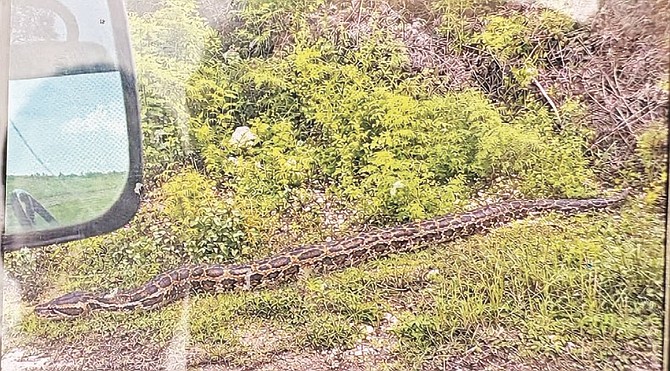
PICTURE taken in Abaco of a Burmese Python snake.
ABACO residents have been warned to stay away from large snakes and immediately report suspected Burmese python sightings as officials investigate whether the potentially invasive species is present on the island.
The Ministry of Agriculture and Marine Resources said yesterday it received a report of a snake in Abaco believed to be a Burmese python and is treating the matter seriously because of the potential threat the species could pose to native wildlife, agriculture and the wider ecosystem if it becomes established.
The immediate question is whether the reported snake is actually a Burmese python and, if so, whether it is a lone animal or evidence of a wider population.
Residents are being asked to report additional sightings immediately and provide the location and time of the sighting. Where it is safe to do so, they are also being asked to provide photographs or video to help officials identify and assess the animal.
Anyone who has already captured or killed a suspected Burmese python is being asked to keep the body as intact as possible so authorities can examine it, determine its sex and collect biological information that could help establish whether the sighting is isolated or whether a population may be present.
Burmese pythons are non-venomous constrictors and among the world’s largest snakes.
Native to parts of southern and Southeast Asia, they kill prey by constriction and swallow animals whole.
Adults commonly grow between ten and 16 feet, although specimens exceeding 18 feet have been recorded.
The snakes can live in wetlands, swamps, grasslands and wooded areas and are also strong swimmers.
They prey on mammals, birds and reptiles, while their size, adaptability and ability to reproduce have made them particularly successful when introduced outside their natural range.
Female Burmese pythons can lay up to about 100 eggs in a clutch, heightening concern about the possibility of the species becoming established if a breeding population develops.
The ministry said it will continue monitoring the situation and provide further information as necessary.
Agriculture Officer Josefina Adderley-Curry can be contacted at 376-5069 to report sightings.




Comments
Use the comment form below to begin a discussion about this content.
Sign in to comment
OpenID