By LEANDRA ROLLE
Tribune Chief Reporter
lrolle@tribunemedia.net
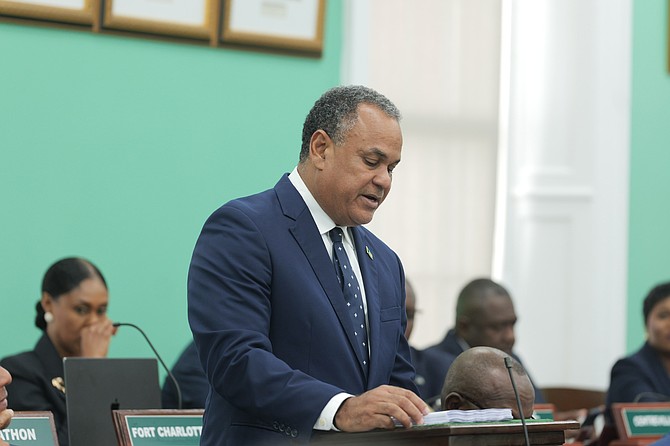
THE Davis administration broke no law when it began spending hundreds of millions of dollars through the National Investment Fund before its board ever convened, Finance Minister Michael Halkitis insisted yesterday, even as he acknowledged that key governance arrangements for the fund remain unfinished.
Mr Halkitis, speaking publicly on the controversy for the first time, said the government relied on parliamentary borrowing authority and the Public Finance Management Act to administer the money through the Ministry of Finance and Treasury while regulations and other NIF arrangements were still being developed.
He said the outstanding framework — including regulations, mandates, committee structures, financial reporting and audit processes — is expected to be completed before the end of the year.
“We’re looking to do it as soon as possible,” he said. “I mean definitely before the end of the year.”
The explanation comes after Central Bank Governor John Rolle confirmed that the NIF’s Board of Governors had never formally convened, despite government fiscal reports showing hundreds of millions of dollars moving into and out of an account bearing the fund’s name.
Government reports showed the fund held $265.3m at the end of December 2025 but just $200,000 by the end of March, a reduction of about $265.1m.
Opposition members contend transactions undertaken through the fund since the account was opened in July 2025 were unlawful because the board had not met the key responsibilities assigned under the National Investment Fund Act.
The concern goes beyond unfinished paperwork. The National Investment Funds Act gives the Board of Governors responsibility for managing the fund, setting its governance rules and investment strategy, and overseeing its banking and investment accounts. It also requires the fund to operate transparently and accountably.
Because the board never met, the central question is who authorised the movement and spending of hundreds of millions of dollars, and under what legal authority. It also raises questions about whether the safeguards built into the law were followed and whether the decisions can now be properly accounted for and audited.
Opposition leader Michael Pintard has instructed attorneys to examine whether the government’s management of the fund breached criminal, constitutional or statutory law and to advise on possible legal remedies.
Mr Halkitis rejected that position.
“We believe that we were in the exercise of the law,” he said. “They have a different opinion. We recognise that there are some administrative things that need to be completed, and we’re going to complete them.”
He said the government had sought legal advice from the Office of the Attorney General on how the Public Finance Management Act, National Investment Funds Act and parliamentary borrowing authority interacted.
“We acted in accordance with that advice and will bring any measure considered necessary before Parliament at the appropriate time,” he said.
Mr Halkitis said the government considered itself authorised to use the fund based on a borrowing resolution passed by Parliament last March.
He said the Ministry of Finance and Treasury administered the money while the NIF’s governance structure was still being completed.
The minister also provided a broader breakdown of how the money was used, saying roadworks and building projects accounted for $210.6m in investments.
Those projects included construction, renovation, acquisition and modernisation of public assets, including roads, a new court complex and an administrative complex.
Another $100.3m was spent on airport development and air connectivity across the Family Islands, covering airport construction, runway and terminal improvements, land acquisition, engineering, project management, surveying and related professional services.
Mr Halkitis cited airport improvements in Cat Island, Long Island, Exuma and San Salvador.
The fund also supported the acquisition of water infrastructure.
His explanation provides more detail than previous government fiscal reports, which disclosed the sharp reduction in the NIF’s balance but did not fully break down the spending.
Questions surrounding the fund intensified after Mr Halkitis previously disclosed that about $700m in excess borrowing receipts had been transferred to the NIF rather than used for deficit financing.
Yesterday, he defended the spending as investment in infrastructure intended to improve public services and transportation links and strengthen public facilities.
“They represent an investment in the proposition that every Bahamian community should have the infrastructure required to participate meaningfully in the country’s progress,” he said.
“This is the wider purpose of national investment: to use resources available today to create enduring public value for tomorrow.”
Mr Halkitis said the government nevertheless accepted that the fund required stronger governance and oversight.
“The stronger the public investment,” he said, “the stronger the systems of oversight, reporting and assurance must be.”
He confirmed that the fund’s Board of Directors was appointed on June 30 and said the remaining administrative arrangements are now being completed.
“The objective is to ensure that future decisions are taken within a clear and settled framework,” he said, “with defined responsibilities, effective oversight and the reporting required by law.”
Mr Halkitis said the Ministry of Finance has the NIF’s financial records and that they will be dealt with through the applicable accounting, reporting and audit processes.
He also said the government would cooperate with the opposition and the Public Accounts Committee as scrutiny of the fund continues.
“It’s their job to ask these questions,” he said. “It’s our job to answer them.”




Comments
Use the comment form below to begin a discussion about this content.
Sign in to comment
OpenID