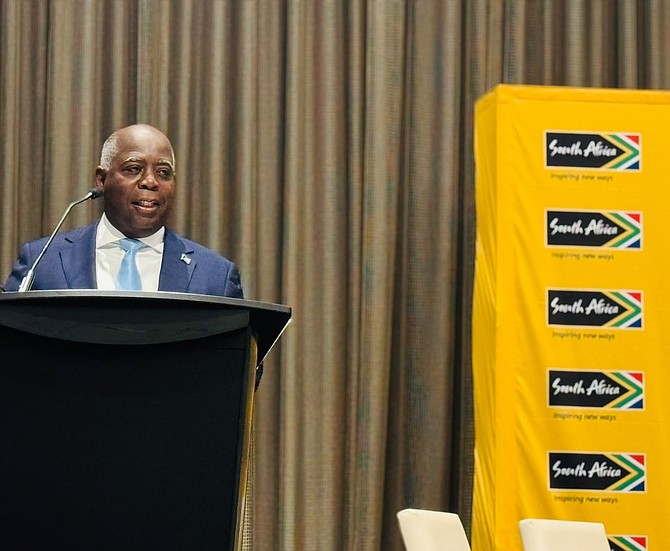
Prime Minister Philip Davis speaking at the Diaspora and Friends of South Africa Roundtable in New York on September 25, 2026.
PRIME Minister Philip “Brave” Davis today called for Africa and the Caribbean to build and own more of the infrastructure through which their people, money and data move.
Speaking at the Diaspora and Friends of South Africa Roundtable in New York, Mr Davis called for investment in data centres, payment platforms, air links and trade corridors connecting African countries with each other and with the Caribbean.
“Remittance is love. Investment is power,” he said. “Love keeps a family alive. Power keeps a nation free.”
Mr Davis also pitched The Bahamas as a potential gateway between Africa, the Caribbean and the Americas, highlighting opportunities in food security, renewable energy, fintech, manufacturing and logistics.
“Let The Bahamas be your gateway to the Caribbean and the Americas,” he said.
The Prime Minister argued that despite longstanding historical and cultural ties, practical connections between Africa and the Caribbean remain weak.
“For most of our life as an independent nation, The Bahamas has looked north,” he said. “North for our visitors, our capital, our markets and our banks. There were good reasons. But in looking north for so long, we forgot to look east, towards the land our ancestors came from.”
He acknowledged that his administration also had work to do to strengthen those links, noting the difficulty of travelling between The Bahamas and South Africa.
Mr Davis framed barriers to travel, financial transactions and control of data as economic opportunities for investors.
He said Sub-Saharan Africa remains the most expensive region in the world for sending money and argued that payments between Caribbean and African businesses often pass through financial institutions elsewhere.
He also pointed to what he described as a significant gap in data infrastructure, saying Africa is home to nearly one in five people globally but has less than one percent of the world’s data centre capacity.
“Digital sovereignty means deciding where our data lives, who may use it and on what terms,” he said. “It means sharing in the value it creates. It means entering the digital age as owners, not only as users.”
Turning to The Bahamas, Mr Davis said the country imports around 90 percent of its food and is working towards generating 30 percent of its electricity from renewable sources by 2030, presenting both areas as investment opportunities.
He also highlighted the country’s developing digital and fintech sectors and Grand Bahama’s free trade zone and deep-water port.
Mr Davis pointed to the government’s relationship with the African Export-Import Bank as an example of growing economic ties. He said The Bahamas signed a $200m framework with Afreximbank in February 2025 for climate-resilient infrastructure and noted that the bank has increased its financing ceiling for CARICOM from $3bn to $5bn.
“African capital is building Caribbean resilience, and earning a return doing it,” he said. “Solidarity is not a speech. Solidarity is a balance sheet.”
Mr Davis invoked the 1985 Commonwealth Heads of Government Meeting in Nassau, where Commonwealth leaders adopted the Nassau Accord calling for action against apartheid, and recalled Nelson Mandela’s subsequent visit to The Bahamas after his release from prison.
He said the challenge for the current generation was to pursue economic and digital freedom.
“In 1985, The Bahamas chose South Africa’s freedom,” Mr Davis said. “In 2026, let Africa and the Caribbean choose each other.”




Comments
birdiestrachan 31 minutes ago
One of the Fnm theme songs they travel too much Why did Rolling go on this trip if they really believe this. Just bluster no substance. Is what they are about.
Sign in to comment
OpenID