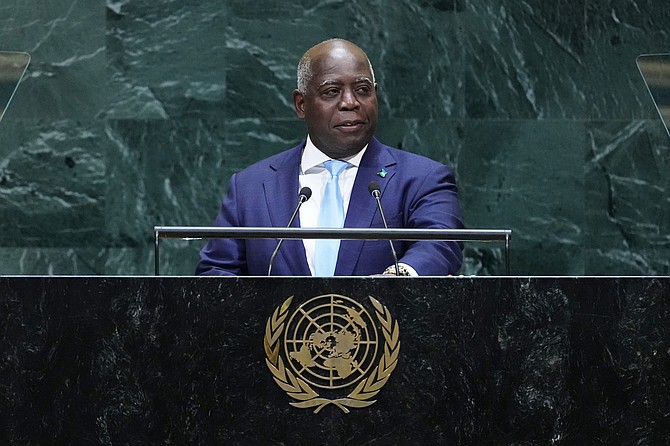
Prime Minister of the Bahamas Philip Edward Davis addresses the 81st session of the United Nations General Assembly at U.N. headquarters Friday, Sept. 25, 2026. (AP Photo/Frank Franklin II)
By LEANDRA ROLLE
Tribune Staff Reporter
lrolle@tribunemedia.net
PRIME Minister Philip “Brave” Davis used his address to the United Nations General Assembly today to forcefully defend the sovereignty of smaller states, telling world leaders: “International order, where rules apply only to the weak, is not order. It is a hierarchy.”
Speaking at the 81st session in New York, Mr Davis also addressed challenges facing the wider Caribbean, making a strong case for greater support for Cuba and Haiti. The UN confirms The Bahamas was scheduled to address the General Debate today.
He reiterated The Bahamas’ position on both countries, calling for an end to the trade embargo against Cuba and greater international aid for Haiti.
He highlighted the ongoing suffering of the Cuban people, appealing for Cuba’s removal from the state sponsors of terrorism list as well as the lifting of the fuel blockade.
“We call on all states to respect Latin America and the Caribbean as a zone of peace,” he added.
Turning to Haiti, Mr Davis cited its history as the first country to successfully attain freedom through a slave revolt.
However, he warned: “For that act of courage, it was made to pay.
“In 1825, under the guns of a foreign fleet, Haiti was compelled to compensate its former colonisers for its own freedom. It took Haiti more than a century and a half to pay that compensation.”
He used Haiti’s experience as an example of “what sovereignty costs” when it is not respected and called on the UN Security Council to renew its mandate and provide the gang suppression force with the resources needed to get results.
He also pointed to CARICOM’s Ten-Point Plan for Reparatory Justice while highlighting the atrocities of slavery.
Mr Davis stressed the importance of former colonisers acknowledging that history, but said “recognition without repair” was not enough.
“We call on the nations that profited to engage seriously with reparatory justice: truth, apology, restoration and development,” Mr Davis continued.
The prime minister’s remarks formed part of a broader criticism of what he described as the UN drifting away from its founding principles of sovereign equality.
He rejected the position that the world is living through a period of uncertainty, adding: “The only uncertain thing is how we respond to the opportunities and challenges of this time.
“Treaties are being torn up. Institutions are being starved. Rules are giving way to deals, and the benefits of the deals go to whoever holds the most leverage,” Mr Davis warned.
He warned against a return to an era in which powerful nations dictate the affairs of smaller states.
“We did not win our freedom to once again become somebody’s backyard. The message to small nations is very clear. Be as sovereign as we allow you to be.”
The prime minister continued: “Mr President, a sovereignty that must ask permission is not sovereignty. It is a lease. Our ancestors did not break their chains so that their children could become tenants.”
Mr Davis also highlighted what he described as a disparity in how rules apply to smaller states and powerful countries, warning that “great powers can survive the end of the rules” but small states cannot.
“International order, where rules apply only to the weak, is not order. It is a hierarchy,” he added.
“When The Bahamas defends multilateralism, we are not defending a bureaucracy. We are defending the only successful arrangement in which a nation of four hundred thousand people can stand at this podium as the sovereign equal of a nation of a billion people.
“A world without rules is not a free world. It is Melos.”
Mr Davis’ address also covered climate change. He announced The Bahamas’ endorsement of the Declaration on Sea-Level Rise, which affirms “that our statehood, our boundaries and our seat in this Assembly will not be washed away by the sea”.




Comments
Use the comment form below to begin a discussion about this content.
Sign in to comment
OpenID