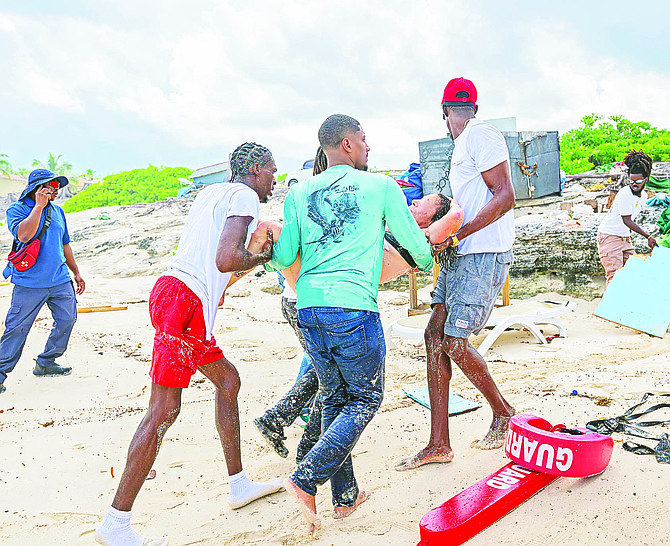
Lifeguards and bystanders, including Freetown MP Lincoln Deal, came to the resuce of a woman swept off Cabbage Beach
By RASHAD ROLLE
Tribune News Editor
rrolle@tribunemedia.net
RESCUERS saved a 60-year-old American tourist from rough seas at Cabbage Beach yesterday after she was swept into the water while trying to get around a controversial fence which protesters say has been erected so close to the shoreline that beachgoers are being forced into the sea to pass it.
Videos captured the chaotic rescue, showing the woman tussling in the waves as people tried to help her.
“We could’ve lost a life,” said Freetown MP Lincoln Deal, who was among those who went to her aid. “That could happen to Bahamians, children, tourists.”
He had been at Cabbage Beach protesting the fence when the woman, reportedly a guest at the Riu resort, ran into difficulty while walking towards the adjoining section of beach.
He said a wave pulled her in and strong currents repeatedly dragged her farther from shore as lifeguards, protesters and others struggled to reach her.
“Thank God we were able to get her breathing again,” Mr Deal said after the woman was brought ashore and given CPR.
An ambulance was called and the woman was seen being stretchered off the beach.
One angry eye witness demanded: “Take down the fence before somebody dies.T ake down the fence before somebody loses their life.”
The dramatic episode unfolded in the middle of a protest over the latest erection of fencing at Cabbage Beach, where a battle over public access and the future of long-standing Bahamian vendors has been simmering for weeks amid construction of the Four Seasons Ocean Club Residences.
Mr Deal said yesterday’s rescue showed why he believes the fence’s location is dangerous.
“That fence is basically in the water,” he said.
Mr Deal said the tourist had been walking along the shoreline, something he said guests from the neighbouring Riu routinely do, but could not move farther up the beach because of the barrier.
“When you’re walking around that fence,” he said, “you’re basically walking in the water, and so it’s very easy to lose your balance, to fall, to be pulled in, to even be pushed and pressed against the fence.”
Mr Deal said the presence of lifeguards and other people yesterday may have prevented a tragedy and questioned what would happen to a tourist or Bahamian caught in similar conditions when no one was around to intervene.
Last night, the government said developers would be told to remove the fence - or it would be removed.
Minister of the Environment Zane Lightbourne said: “The Government of The Bahamas has an uncompromising position on Bahamians’ access to their beaches. The position applies to every developer operating in our country.”
He said permission for a temporary fence to be erected was done so without the necessary notice period and without the required public advisory period taking place.
The fence is the second to cause an uproar at Cabbage Beach in a month.
Vendors arrived at the Paradise Island beach in late August to find fencing being installed close to the shoreline, prompting fears that high tides would leave them without enough space for their stalls, chairs, umbrellas and water-sports operations. Some have worked at Cabbage Beach for decades.
The Ministry of Tourism subsequently disclosed that the work had gone ahead before consultations it expected with the developer had taken place.
According to the ministry, it had met representatives of the adjoining property and understood that a joint walk-through would be held to assess the plans and their effect on vendors. That inspection did not happen. When the ministry later learned work was about to begin, it requested another meeting, but the developer allegedly proceeded before that engagement took place.
The fence was removed on August 30 following intervention by the Department of Environmental Planning and Protection.
But the government’s position subsequently shifted as attention turned to erosion at the beach.
Earlier this month, the Ministry of Tourism said DEPP had advised that measures were needed to address “severe beach erosion” and protect and renourish the affected area. It said fencing and pilings were expected to form part of those works and would temporarily affect sections of the beachfront and places where vendors currently operate.
The ministry insisted the measures were temporary and intended to protect the beach and public safety, rather than restrict the public’s right to use Cabbage Beach.
Mr Deal yesterday demanded that the barrier be removed immediately or shifted, claiming it does not follow the property’s boundary.
He also questioned the government’s reliance on erosion as justification for the works, arguing that erosion is occurring along the wider stretch of coastline and claiming the development’s environmental impact assessment itself addresses erosion associated with the project.
Earlier this month, Mr Deal demanded written guarantees for licensed vendors facing temporary displacement, including certainty that they can return after the erosion works and construction are completed.
The Ministry of Tourism has said it is working with licensed vendors, DEPP and other stakeholders to find temporary locations where affected operators can continue working.
Twenty-seven remaining vendors were reported earlier this month to be facing relocation amid negotiations over compensation. Dis We Beach said at the time that there was still no written agreement guaranteeing their return once construction of the $550m development is finished.
Plans for the development nevertheless contemplate continued public access. Its environmental impact assessment pledged beach access during the three-and-a-half-year construction period, including protected passage through the construction site during part of the work.
Once construction is completed, plans call for Cabbage Beach to remain accessible through a 15-foot-wide landscaped pathway, with vendor facilities alongside it and existing vendors given preference for kiosks leased for a nominal $1 per month.
Dis We Beach says those plans and assurances still leave unanswered a more immediate question: who authorised the fence where it now stands?
The group is demanding that the government publish the surveyed fence line, show its position relative to the mean high-water mark and identify who owns and controls the land occupied by the proposed works.
It has also turned attention to the original approvals for the development, pointing to section 37(3)(j) of the Planning and Subdivision Act, which it said allows Town Planning to make maintaining or providing beach access a condition of development approval.
The group wants the government to say whether it imposed such a condition and, if so, what it requires.
Dis We Beach has also questioned what consideration was given to the development’s effect on people whose livelihoods depend on the beach.
It said the Environmental Impact Assessment Regulations require consultation to address potential social and economic effects and impacts on nearby communities. At Cabbage Beach, it said, this includes vendors, taxi drivers, tour operators and beachgoers, as well as the wider tourism economy.
The group is also demanding more evidence for the government’s “severe beach erosion” explanation.




Comments
bahamianson 5 hours, 37 minutes ago
What does the law say about the high water mark and private property? The realtors should be fined $10,000 when they do not make buyers aware of the high water mark situation. The owner should be fined anytime they break the law, say , $5,000 for first offense. All beach assess roads along bay street should be labeled “PublicBeach Access”. Any person or company that blocks or hinders the pathway by erecting a wall or fence should be fined$5,000. We will never have a problem again.
Sign in to comment
OpenID