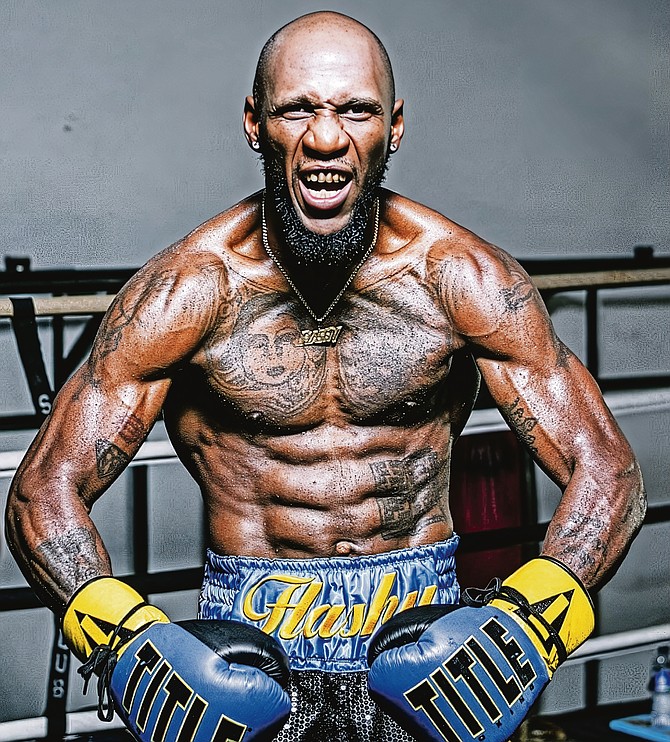
BAHAMIAN professional boxer Carl “King Flashy 242” Hield
By JONATHAN BURROWS
Tribune Sports Reporter
jburrows@tribunemedia.net
Bahamian professional boxer Carl “King Flashy 242” Hield is challenging his classification under the government’s 2026-27 National Elite Athletes Subvention Programme, arguing that the system does not properly account for his accomplishments in boxing.
Hield is listed in the Elite Emerging category, the lowest of the programme’s four published athlete tiers, which carries an annual payment of $14,000.
But Hield believes his current classification fails to reflect where he stands in the sport.
The 40-year-old is undefeated as a professional with a 17-0 record and 17 knockouts. He holds the WBA FedeCaribe, WBC FECARBOX and NBA Latin titles, according to information provided by Hield and his team, and is continuing to pursue opportunities at the highest level of professional boxing.
Hield has formally written to the Ministry of Youth, Sports and Culture requesting that his classification be reconsidered based on his professional achievements.
The dispute has also raised broader questions about how athletes from different sports are evaluated under the government’s subvention programme.
The Ministry has allocated approximately $2.05 million to the programme for the fiscal year. Under the current structure, athletes classified at the World level receive $36,005, Elite athletes receive $28,400, Performance athletes receive $21,600 and Elite Emerging athletes receive $14,000.
The payments have also been changed from a monthly structure to four three-month installments. Director of Sports Kelsie Johnson-Sills said the first payment was retroactive to June, with subsequent payments scheduled around November or December, March and May.
Ron Rogers, owner and head coach of Strikers Boxing Club and Hield’s manager, said Hield’s classification as an Elite Emerging athlete does not accurately reflect his career.
“This subvention programme is supposed to be something that can be allocated to athletes that represent the country at its highest level, at intermediate levels,” Rogers said. “But they currently have Carl down as a development athlete, which is pretty much a beginner.”
Hield has represented The Bahamas internationally since his amateur career, winning a bronze medal at the 2010 Commonwealth Games and silver at the 2014 Central American and Caribbean Games.
He later transitioned into professional boxing and has remained unbeaten through 17 fights.
Rogers said the distinction is particularly important because Hield is no longer an athlete attempting to establish himself internationally.
“He has represented us on the highest level,” Rogers said. “Now he’s professional and he’s at the highest level as a professional. He’s 17-0. He hasn’t lost a fight. He’s undefeated and he also has three belts.”
Hield said his professional accomplishments should be evaluated differently from athletes in sports where performance can be measured through times, distances or other standardized statistics.
“You cannot measure a boxer’s career using a sprinter’s stopwatch,” Hield said in his submission to the Ministry. “In boxing, we don’t have timed heats. It is a win-or-lose sport where you risk your physical safety every time you step into the ring.”
That distinction is at the center of Hield’s argument.
He believes the Ministry should consider factors such as professional records, championship belts, title defenses and international rankings when evaluating boxers rather than applying broad criteria across every sporting discipline.
“I am not developmental,” Hield said. “I am operating at the highest level of my sport.”
The Ministry’s programme also includes a pension plan available to athletes, according to Johnson-Sills.
Hield’s camp believes the issue is not simply the amount of money he receives.
Rogers believes the classification itself sends the wrong message about the level at which Hield is competing.
“At any moment, he can be called for a world title fight,” Rogers said. “The country only has one world champion. If he’s called to fight for a world title and we only have one world champion, he could be the second. You can’t get any higher than that.”
Hield’s team has submitted a breakdown of his accomplishments to the Ministry as part of the request for reconsideration.
Rogers said Hield has also met with Ministry officials but believes the discussions have not provided a satisfactory explanation for his classification.
“Carl sat down with them numerous times, and they keep giving him the same runaround,” Rogers said.
Johnson-Sills previously said the programme did not have formal criteria in the past, with the Ministry largely following recommendations submitted by national sporting federations.
“What we in the ministry did was seek legal advice from the Attorney General’s Office because we wanted to bring the subvention plan into a global structure,” Johnson-Sills said in comments published by The Tribune.
She also said athletes receiving subvention have obligations, including community service and participation in national competitions at the level at which they compete internationally.
Hield argues that boxing cannot be evaluated through the same measurements used for track and field because the sports have fundamentally different competitive structures.
“In boxing, we don’t have timed heats,” Hield said. “It is a win-or-lose sport where you risk your physical safety every time you step into the ring.”
Hield also believes the issue extends beyond his individual case.
He believes athletes in sports such as boxing, judo and taekwondo, as well as team sports, can be disadvantaged when their accomplishments are measured against criteria that do not account for the structure of their respective sports.
“This isn’t just about me or boxing,” Hield said. “It affects judo, taekwondo and team sports like basketball and baseball.”
The Ministry’s published list includes athletes from more than 20 sporting disciplines, including boxing, swimming, tennis, basketball, baseball, judo, volleyball, wrestling, gymnastics, sailing, golf, bodybuilding, equestrian, cycling, soccer, billiards and darts.
Johnson-Sills said the list was shared with the Bahamas Olympic Committee, with some individuals recusing themselves when there was an affiliation with a particular athlete.
Hield is calling for the structure to become sport-specific.
“We are asking the Ministry to reform the subvention criteria to be sport-specific,” Hield said. “True fairness means evaluating a boxer by their title defenses and bracket wins, not by a track point table.”
Rogers also believes the physical risks involved in boxing should be considered when determining the level of support given to fighters.
He argued that boxing is fundamentally different from most other sports because there are no heats, substitutions or second chances once a bout begins.
“In boxing, once you lose, no matter how many punches you throw or how well you did in the fight, once you lose, that is it,” Rogers said. “There is no second chance.”
The Ministry has said the programme is designed to support athletes attempting to reach the professional level and compete internationally, while also requiring athletes to maintain certain obligations as representatives of The Bahamas.
Hield’s camp is asking the Ministry to reassess where he fits within that structure.
The request comes as Hield continues his professional career and works toward another championship opportunity.
An official letter has been submitted to the Ministry requesting reconsideration of his tier based on his professional accomplishments.
“I am not here to tell the Ministry how to do their job,” Hield said. “I am simply asking for a fair, sport-specific evaluation that understands international championship belts.”
Rogers believes the decision could have implications beyond Hield.
He said athletes who represent The Bahamas should feel that their accomplishments are recognized when they return home from international competition.
“Give him his due,” Rogers said. “He’s represented the country since he was a kid, in the amateurs, and now he’s in the professional ranks and doing very well. He’s undefeated. Give him his due respect. Put him on a level he should be at.”
“I have earned my respect in the ring,” Hield said, “and it’s time the Ministry’s rulebook reflects that same respect.”
The Ministry has not indicated whether Hield’s classification will be changed following his request.




Comments
Use the comment form below to begin a discussion about this content.
Sign in to comment
OpenID