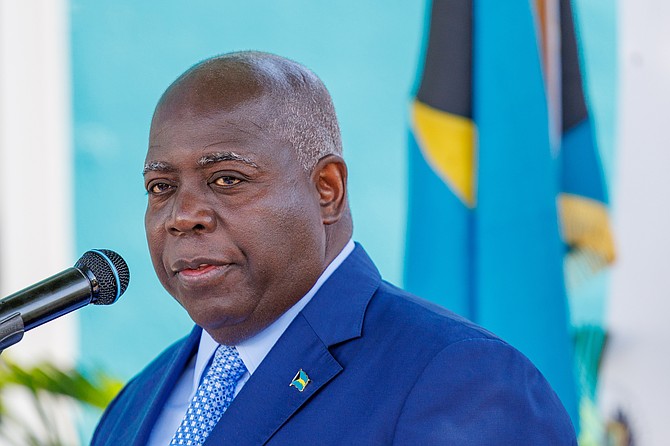
Prime Minister Philip Davis. Photo: Dante Carrer/Tribune Staff
By LYNAIRE MUNNINGS
Tribune Staff Reporter
lmunnings@tribunemedia.net
PRIME Minister Philip "Brave" Davis has broken his silence on the row over undercover US Drug Enforcement Administration operations in The Bahamas, insisting his government has nothing to fear from agents targeting criminals.
His comments came after US Ambassador Herschel Walker publicly challenged the Davis administration over its complaint that DEA agents had operated in The Bahamas without the knowledge or authorisation of local authorities.
Mr Davis said he did not believe the dispute would tarnish relations between the two countries. He said the government's complaint was about the process countries follow when working together, not about going after criminals.
Asked yesterday on the sidelines of an event what the government had to fear if the US agents were targeting criminals, Mr Davis did not directly answer the question. He instead pointed to Mr Walker's earlier comments on the matter.
"Well, first of all, it's not what we fear," he said.
"We're not fearing anything. It's not a question of fearing targeting criminals. We all want to get criminals out or ensure that they pay for their crimes. It's not about targeting criminals at all, it's a question of the process. There's a process that exists between countries as to when and how we engage like this; all that is being asked for is the process we follow."
The process Mr Davis wants followed would require US agents to notify Bahamian authorities of their operations, even though the investigation at the centre of the row alleges that a Bahamian politician met an undercover DEA source inside Parliament to discuss a cocaine shipment.
Asked whether the public back-and-forth between Bahamian and US officials could damage relations, Mr Davis said: "I don't think so."
"I take, quite frankly, as I said to my people," he said, "we ought to take the advice of the ambassador. What did he say? Just let us wait and see. So I take his advice, and I think we ought to just wait and see."
The remarks are Mr Davis's first substantive public response to the increasingly pointed dispute, in which senior Bahamian and US officials have traded criticisms over how American drug investigations are carried out on Bahamian soil.
They come just days after he used his address to the United Nations General Assembly to stress the importance of sovereignty and international rules. In that speech, he warned that smaller states would be among the first affected if the rules-based international order were weakened.
The row erupted last week when Bahamas Ambassador to the United States Wendall Jones confirmed that a Bahamian delegation had raised concerns with US Justice Department officials. The concerns were about what the government believes were unauthorised or "rogue" DEA operations in The Bahamas.
The delegation included senior Bahamian law enforcement and intelligence officials. It met acting Deputy Assistant Attorney General Brian Skaret and other US officials.
Mr Jones said Bahamian authorities believed undercover US agents had operated outside the existing treaties and arrangements that govern law enforcement cooperation between the two countries.
Mr Walker responded forcefully. He dismissed the suggestion that DEA agents had operated illegally as "fake news" and questioned why Bahamian officials were concerned about US authorities helping to arrest a known drug trafficker.
He later urged the Davis administration to work with the United States to combat drug trafficking, warning that America could no longer accept the flow of drugs to its shores.
The ambassador had also previously urged people to "wait and see" regarding the wider US investigation. He said it remained open and that public comments could prejudice either side.
The dispute stems from US court filings in the prosecution of Bahamian Jonathan Eric Gardiner, also known as "Player". The filings revealed details of a three-year DEA investigation that involved undercover activity in The Bahamas.
US prosecutors allege Gardiner was involved in an international cocaine trafficking conspiracy. Court documents also allege that an unnamed Bahamian politician, identified only as "Politician-1", met an undercover DEA source and a drug-mule pilot inside Parliament in October 2024 to discuss a proposed cocaine shipment through The Bahamas.
The alleged shipment was said to involve about 1,000 kilogrammes of cocaine, with an estimated value of about $30m. US prosecutors have not publicly disclosed the identity of "Politician-1".
The allegations have drawn further scrutiny because of what Gardiner was carrying when he was arrested. He was detained by US authorities after surviving an Election Day plane crash off the Florida coast in May, and was found with about $30,000 in Bahamian currency. US court documents said the cash was in a bag bearing a handwritten name that was redacted and identified only as "Politician-1".
The Tribune has also reported that Gardiner acknowledged in US court filings that he controlled a bank account belonging to Top Notch Builders. The company is connected to major Bahamian government construction projects, including the Eight Mile Rock administrative complex and the Carmichael Village housing development.
Attorney General Wayne Munroe has recently defended the government's complaint. He argued that foreign law enforcement officers must respect Bahamian laws and procedures when operating in the country.
Mr Munroe said the issue was not whether The Bahamas wanted to stop the United States from investigating drug trafficking, but whether US agents were properly coordinating with Bahamian authorities. He said local law enforcement involvement could prevent Bahamian officers from unknowingly arresting foreign undercover personnel involved in an apparent drug transaction.
The Bahamas has a longstanding counter-narcotics relationship with the United States through Operation Bahamas, Turks and Caicos (OPBAT). Established in 1982, OPBAT provides a formal framework for US counter-drug personnel and aircraft to operate in The Bahamas, with US and Bahamian agencies working together on drug interdiction. The arrangement has been credited with numerous drug seizures over the decades.




Comments
Use the comment form below to begin a discussion about this content.
Sign in to comment
OpenID