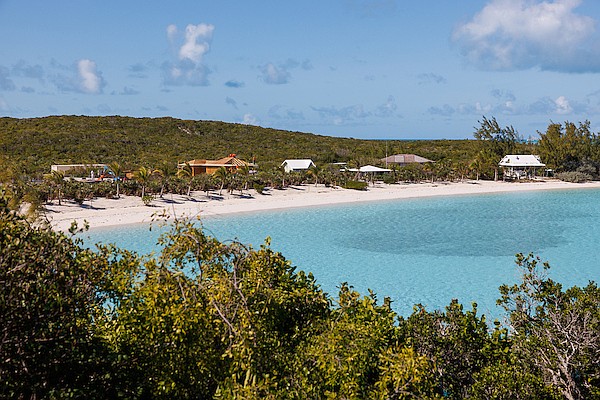
Construction along the beach during a media tour of Turtlegrass Resort on Big Samson Cay, Exuma on January 28, 2025. Photo: Dante Carrer/Tribune Staff
By FAY SIMMONS
TRIBUNE Business Reporter
jsimmons@tribunemedia.net
ATTORNEYS for the $200m Rosewood Exuma project’s key opponent yesterday told the Supreme Court that regulators had no power to extend an environmental approval for work at the development site after it had already expired.
Fred Smith KC, representing Turtlegrass Resort & Island Club, told Justice Leif Farquharson KC that certificate of environmental clearance (CEC) 2400A expired on October 8, 2025, but was subsequently extended by Dr Rhiana Neely-Murphy, director of environmental planning and protection.
Mr Smith argued that once the certificate expired, there was nothing left to extend and the developer should instead have been required to submit a fresh application and undergo the statutory environmental approval and consultation process.
“It had expired, so there was nothing to extend, and therefore there was no power to do so,” said Mr Smith. The argument formed part of the second day of the Judicial Review challenge brought by Turtlegrass against environmental approvals for the Yntegra Group’s Rosewood Exuma development at East Sampson Cay.
Mr Smith said the issue was not simply whether Dr Neely-Murphy had the power to extend the duration of a valid CEC, but whether that power remained available after the certificate itself had expired. “The statutory scheme requires environmental clearance before work begins or continues,” he said.
He argued that allowing expired CECs to be revived would undermine the environmental approval system and create uncertainty for developers, neighbouring property owners and other interested parties.
“What we will have is a series of zombie CECs that could be resuscitated to haunt people after they were supposed to be dead and interred,” said Mr Smith.
Turtlegrass is challenging the legality of the environmental approval process surrounding its neighbouring resort, including the scope of the environmental impact assessment (EIA), public consultation and the treatment of separate components of the wider development.
Peter Village KC, also representing Turtlegrass, yesterday focused heavily on what he described as inconsistencies between the project that was assessed and later plans contained in the Environmental Management Plan (EMP).
He pointed to the proposed North Bay service dock, saying an earlier plan showed a jetty of about 247 feet while a later EMP showed a structure measuring about 390.5 feet.
Mr Village argued that the difference was significant because the public and environmental regulators should be assessing the same project throughout the approval process.
“You can't have a paper chase. But even worse than that, you can't have inconsistent plans. You can't consult on inconsistent proposals,” said Mr Village. “What's been assessed doesn't accord with what's proposed in EMP revision two.”
Mr Village also challenged the treatment of geotechnical and enabling works associated with the development. He pointed to material produced by the developer which, he said, acknowledged that geotechnical works could have significant negative environmental impacts.
Mr Village argued that those works were more substantial than simply preliminary investigations, pointing to clearing and other physical activity that had taken place on the site.
“What you did see is that over days in July and August ... they came with their bulldozers and cleared vast swathes of land,” he said. Mr Village argued that the environmental assessment should have properly addressed the potential effects of those works rather than treating them as too minor to warrant detailed consideration.
Mr Village also challenged the EIA's treatment of what it described as “severe” environmental effects. He pointed to the EIA's definition of severe impacts as permanent or irreversible changes, and said the assessment identified 27 such effects, including impacts involving hydrology, terrestrial habitats, marine habitats and terrestrial fauna.
“The EIA doesn't tell us why the development is acceptable given the severe impacts and effects which are identified,” said Mr Village. He further argued that mitigation measures identified in later documents did not materially alter the impact assessments contained in the EIA.
“The impacts are identical,” said Mr Village, arguing that the conclusion was that the proposed mitigation measures had not materially changed the identified impacts.
Wastewater was another area of concern raised by Mr Village, who said the proposed development could generate approximately 246 to 381 cubic metres of wastewater per day. He argued that the detailed arrangements for dealing with the wastewater had effectively been deferred to the EMP rather than being sufficiently resolved at the EIA stage.
“Well, eventually, after all that, with consultees asking, ‘What? How are you going to deal with wastewater?’ Well, we'll deal with this with the EMP, and the EMP says, ‘Well, we'll let you know in due course,’” said Mr Village. “Too late. We want to know now.”
Ramauld Ferreira, representing the Over Yonder Cay developer, Yonder Holdings, also adopted several of Turtlegrass's arguments while raising concerns about the potential effects of the Rosewood development on its neighbouring property.
Mr Ferreira pointed to the around 1,000-yard distance between the two developments, and argued that the EIA did not adequately assess the effect of Rosewood's North Bay development on Over Yonder Cay.
He raised issues including marine traffic, movement between the two developments, potential effects on the marine environment and changes in sand movement and siltation.
Mr Ferreira said the environmental documents did not adequately address the impact of the Rosewood development on its neighbour. He also suggested that the outcome of the Judicial Review could have implications beyond the two developments involved in the case.
“What we decide here really determines what other developers have to comply with,” Mr Ferreira told the court. He said the case could help determine the requirements that future developers would have to meet when seeking environmental approval for projects in The Bahamas.
The arguments form part of Turtlegrass's wider challenge to the environmental approvals granted for the Rosewood Exuma development, which has been described as a $200m project.
The applicants are challenging, among other matters, whether the project was properly assessed as a whole, whether the public was given adequate information during consultation, whether subsequent changes to project plans required further assessment and consultation, and whether certain environmental clearances remained legally valid.
The respondents' positions are being advanced during the ongoing Judicial Review hearing before Justice Farquharson today.




Commenting has been disabled for this item.