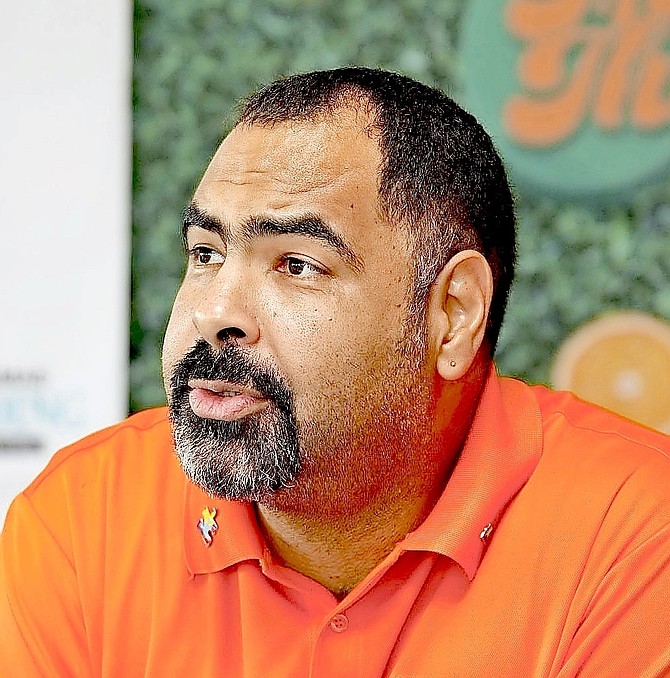
Gowon Bowe
By NEIL HARTNELL
TRIBUNE Business Editor
nhartnell@tribunemedia.net
STANDARD & Poor’s has issued “a tempered warning” over the threat posed to The Bahamas’ public finances by loss-making enterprises such as Bahamasair, a senior banker said yesterday, while also sounding the alarm over “off balance sheet financing”.
Gowon Bowe, Fidelity Bank (Bahamas) chief executive, told Tribune Business that the credit rating agency, which reaffirmed The Bahamas’ existing ‘BB-’ standing and imposed a ‘stable’ outlook on the country’s finances, had sent a “coded message” to the Government that it must ensure it accounts for the National Investment Fund’s (NIF) $311m spending plus multiple private-public partnerships (PPP) using the same standards its applies to regular Budget spending.
He spoke out after S&P’s annual Bahamas report argued “it’ll be tough” for the Davis administration to achieve its targeted Budget surpluses “absent meaningful fiscal reform”, which suggests further austerity measures such as new and/or increased taxes plus spending cuts are required to eliminate persistent annual fiscal deficits.
The rating agency added that controlling government spending will be key, but said this will be challenged by “limited fiscal space” including the 14 percent share of total expenditure consumed by loss-making state-owned enterprises (SOEs) such as Water & Sewerage Corporation and the Public Hospitals Authority (PHA) through taxpayer subsidies and subventions to keep them afloat.
Describing efforts to improve SOE financial performance as slow, S&P also voiced concern about the Government’s guarantee of the $280m borrowing that financed its Grand Bahama Power Company purchase as “further straining its fiscal accounts”. The Davis administration’s own pre-election update revealed the GB Power borrowing would more than double government guarantees for SOEs, raising these from $317.4m at end-December 2025 to $718.1m in this 2026-2027 fiscal year.
“Transforming the typically loss-making SOEs through reforms has been a long-running challenge for the Government. We also think the Government's recent purchase of the Grand Bahama Power Company could strain its fiscal accounts further and limit the reductions it expects for subventions to public entities,” S&P asserted.
“As a result, we think general government debt could increase for reasons other than the Budget balance - namely, off-balance sheet financing and, potentially, the materialisation of contingent liabilities. All that said, with a growing economy, we expect annual increases in The Bahamas' general government net debt averaging 2.5 percent of GDP (gross domestic product) over 2026-2028.”
Mr Bowe, who sat on the original Fiscal Responsibility Council, one of the key watchdogs for the public finances, told Tribune Business that the Government cannot afford to ignore the emphasis S&P placed on the risks created by loss-making SOEs and the need “to accelerate” their structural reform. And nor should it dismiss its guarded, almost-disguised warnings about spending via the National Investment Fund and PPPs such as those for Family Island road projects.
The Fidelity Bank (Bahamas) chief asserted said the term “off balance sheet” should never be used when speaking about a government’s finances. And he warned against using special purpose vehicles (SPVs), some of which have been incorporated to facilitate PPPs, to hide or conceal liabilities such as payables and debt, and prevent them from appearing in the Government’s Budgetary accounts.
The Opposition and others have accused the Davis administration of using PPPs, such as Bahamas Striping’s Exuma and Eleuthera road projects, as a form of “off the books” loans to prevent this spending from blowing its deficit targets and adding to the $13bn-plus national debt. They have made similar allegations about the account in the National Investment Fund’s name being used for similar purposes to keep pre-election spending from causing it to miss Budget forecasts
Mr Bowe yesterday asserted it was vital that the Government answer these charges about the National Investment Fund and its use otherwise whatever Budget deficit/surplus number is finally revealed for the 2025-2026 full year will “face challenges to its credibility.
After S&P repeated its SOE concerns numerous times, he added: “What I will say is there’s particular emphasis that was should not under-estimate or fail to give due attention to. It is the highlighting of the particular exposure associated with the SOEs but, more importantly, what they term contingent liabilities.
“The reason why I say don’t under-estimate them highlighting that is particularly in light of the conversation with the National Investment Fund, what’s been going on with the status of Bahamas Power & Light (BPL) and Bahamas Grid Company, and the need for support from the Government in various areas.
“This is what I’m going to call a tempered warning that the Government must accelerate its reform of SOEs to ensure they don’t become a threat to central government’s debt obligations. This has been repeated multiple times, which indicates the significance they see with contingent liabilities.”
Taxpayer subsidies to loss-making SOEs are forecast to increase by more than $103m to $655m during the upcoming 2026-2027 fiscal year, driven largely by expanded healthcare spending.
And the 2026 Fiscal Strategy Report revealed that Bahamian taxpayers are owed half-a-billion dollars in outstanding loans by these same SOEs, with nine key government entities collectively plunging into “negative equity” with debt liabilities exceeding their assets.
S&P sounded the SOE alarm multiple times in its 2026 annual report on The Bahamas, warning: “State-owned enterprises may continue to face financial sustainability challenges that imply potential larger contingent liabilities and could weigh on the sovereign debt burden.” It, however, voiced confidence that the Davis administration “will manage contingent liabilities from state-owned enterprises in a way that doesn't put its debt trajectory at risk”.
Giving somewhat contradictory noises, the rating agency added: “Delays in reforms at state-owned enterprises (SOEs) could pressure fiscal accounts. And larger contingent liabilities, although we view them as manageable, could translate into a higher debt burden…..
“While the Government has demonstrated its commitment to fiscal sustainability, and has been able to reduce the deficit on the back of the country's economic resilience, several loss-making SOEs could impact the country's public finances.
“This risk has been augmented, for instance, through the purchase of the Grand Bahama Power Company, which has increased the Government's contingent liabilities and could translate into increased subventions. SOE financial sustainability has been a long-standing challenge, and in our view, efforts to improve various loss-making entities have been slow.”
Mr Bowe, meanwhile, said S&P’s concerns about off-balance sheet spending and financing, via PPPs and the National Investment Fund, while more nuanced and oblique were still incorporated into its 2026 report. The rating agency warned, without referring to these two issues by name: “Solid growth will lead to small fiscal deficits, but off-balance sheet financing and contingent risks could keep the debt burden elevated…
“As a result, we think general government debt could increase for reasons other than the budget balance - namely, off-balance sheet financing and, potentially, the materialisation of contingent liabilities.” The Fidelity chief, describing this as a “coded message”, told Tribune Business that the term ‘off balance sheet’ should not be in the discussion we’re having in relation to the Government.
“This is what I’m saying I think they are getting to,” Mr Bowe said. “It’s not even the PPPs, but the SPVs established for the purpose of these PPPs. What this is making reference to is the monies of central government being directed to SPVs for the purpose of PPPs that are not being accounted for according to the principles consistent with central government accounting.”
While the existence of many PPPs, and the SPVs incorporated to hold them, has been disclosed, Mr Bowe argued that the real issue is how their activities have been accounted for in the Government’s finances.
“What we have not articulated is the financial contributions that have gone into them, and how we have accounted for them based on the Government’s accounting principles and how these SPVs account for their expenditure and investment, and how that’s going to impact the financial performance of the Government,” he told Tribune Business.
“If I send money into an SPV, and that SPV develops a building or a road, is central government going to record that as capital expenditure under its modified cash basis of accounting? The danger is an inconsistent accounting position between the central government and SPV.
“If there are liabilities in these SPVs that are payables or debt obligations not showing up in the central government’s liability reports or debt obligations, things are being intentionally kept off balance sheet.” In this way, Mr Bowe explained, some of the Government’s debt obligations can be concealed or “potentially hidden” for a period of time.
“There must be careful attention given to this highlighting by [S&P],” he reiterated. “This ‘off balance sheet’ term is not one I want to see repeated by them. The Government should clarify that we have no such arrangements. We have SPVs established, but all their liabilities are accounted for by the central government to address what they said.
“I’d want to see significant effort by the Government to change the narrative and demonstrate these are simply liability management vehicles - containing separate assets and liabilities - but not creating any debt obligations.” Mr Bowe argued that it is also “naive to believe” S&P are unaware of the National Investment Fund controversy even though it blew up after their team left The Bahamas, adding that the “off balance sheet” term refers to it as well as PPPs.
“The conversation around the National Investment Fund is going to be critical,” he added, “because if recurrent and capital expenditure through the National Investment Fund, it raises questions of lack of credibility surrounding what the deficit and surplus numbers are. It’s important that the Government addresses these questions to put to rest any challenge to the credibility of the numbers being reported.
“There’s certainly a lot of questions that need to be answered relative to the National Investment Fund. We need to focus on governance issues, and what went into the Fund and out of the Fund, and account for it.”
Neither Michael Halkitis, minister of finance, nor Senator Latrae Rahming, the Prime Minister’s communications director, responded to Tribune Business questions and requests for the Government and Ministry of Finance to comment on the S&P report before press time last night.




Comments
Use the comment form below to begin a discussion about this content.
Sign in to comment
OpenID