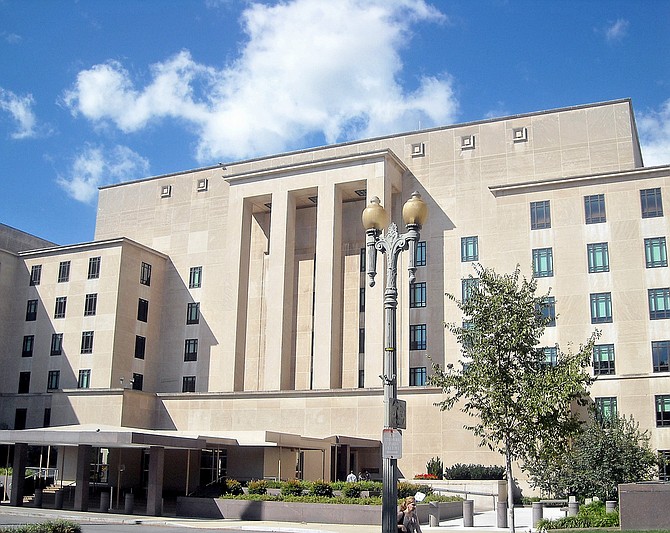
US Department of State headquarters
By NEIL HARTNELL
TRIBUNE Business Editor
nhartnell@tribunemedia.net
THE US government yesterday said multiple corruption, fraud and drug trafficking allegations involving ex-politicians, high society members and security forces personnel “underscore governance and rule of law challenges in The Bahamas”.
The Trump administration’s State Department, unveiling its annual ‘investment climate statement’ report, cited multiple ongoing court proceedings - both in the US and this jurisdiction - as well as recent convictions and guilty pleas as underscoring the threat posed by “public corruption” and how it “adversely impacts the investment climate of The Bahamas”.
While calling no names, the report’s expanded section on “corruption” mentioned numerous cases that were easily identifiable based on The Tribune’s records. One involved Sonny Miller, a former assistant superintendent of police, ex-head of the Police Staff Association and the highest-ranking officer on Acklins at the time, who was sentenced to six years in prison in February 2026 over the smuggling of $1.4m worth of cocaine and $34,000 worth of marijuana.
Other cases mentioned in the State Department report included that of Elliott Lockhart KC, an ex-Supreme Court judge and former Exuma MP, who is accused of misappropriating $3.6m in client funds and is now the subject of both a US arrest warrant and asset forfeiture proceedings. It also referred to the case involving Michael Johnson, former head of the Royal Bahamas Police Force’s criminal investigation department, over bribery claims related to an armoured car robbery.
Besides the New York drug trafficking proceedings involving Chief Superintendent Elvis Nathaniel Curtis, former head of The Bahamas’ airport police, and chief petty officer Darrin Roker of the Royal Bahamas Defence Force, the latter of whom has been sentenced to four years’ in prison after striking a plea deal, the US report then mentioned the $750,000 fraud allegations against Lanisha Rolle, the ex-Cabinet minister, which remains before the Bahamian courts.
Finally, the US State Department also referenced ongoing proceedings against ex-Water & Sewerage Corporation executive chairman, and former Long Island MP, Adrian Gibson. Prosecutors yesterday dropped 18 charges against Mr Gibson to leave him facing just 41 - one count of making a false declaration, three counts of conspiracy to commit bribery, 12 counts of bribery and 25 counts of money laundering.
None of the cases referenced in the report, apart from Mr Miller’s and Mr Roker’s plea deal, have resulted in a conviction and all others named deny the charges and allegations against them and are contesting them in ongoing proceedings. However, the US report implied that, collectively, they give rise to its growing concerns over governance in The Bahamas.
And, in a seeming hardening of its language compared to previous reports, the State Department said: “A series of high-profile corruption, fraud and drug trafficking cases involving law enforcement, former MPs and other public officials has continued to underscore governance and rule-of-law challenges in The Bahamas…..
“In addition, authorities have intensified efforts to combat document fraud and strengthen national security systems. As of early 2026, investigations into passport fraud have identified nearly 100 suspected cases involving falsified documentation, sham marriages and fraudulent citizenship applications.
“Dozens of individuals have been arrested and charged, and internal reviews have raised concerns about potential insider involvement within government offices. Policy reforms have since been implemented to tighten verification procedures and reduce vulnerabilities in the passport issuance process,” the US report, likely leaning heavily on information provided by the Nassau embassy, asserted.
“Collectively, these cases highlight ongoing enforcement actions and international co-operation in combating public corruption, which continues to adversely impact the investment climate of The Bahamas.”
The US State Department’s report likely could not have been released at a worse time for US-Bahamas relations, which have been strained in recent weeks over claims that Drug Enforcement Administration (DEA) agents have been operating illegally in The Bahamas. This follows claims, documented in legal papers filed with the US courts, that DEA undercover agents and informants met with “politician one” in the House of Assembly to discuss a drug shipment.
This was part of the investigation connected to Jonathan Eric ‘Player’ Gardiner, who was seized by US authorities following his rescue from the May 12 general election day plane crash and charged with multiple drug offences in two separate US federal courts. And it was also likely linked to the probe into Curtis, Roker and the others who have been indicted. The Government has formally complained to its US counterparts of activities by DEA agents.
With the report likely to further inflame US-Bahamas tensions, the State Department also renewed previous criticisms that The Bahamas has passed multiple anti-corruption laws but never effectively enforced them by providing the necessary regulations and/or resources required for implementation.
Pointing, in particular, to the Public Disclosure Act that mandates all MPs, senators and senior public officials file annual declarations of their net worth, including assets, income and liabilities, the US report said the last time such disclosures were published according to the law was in 2011 - some 15 years ago. And that only covered declarations up to 2008, making them now 18 years-old.
“The Public Disclosure Act mandates that senators, MPs and senior public officials file annual declarations of assets, income and liabilities to the Public Disclosure Commission,” the US State Department said. “However, compliance has been sporadic, and the Commission has failed to publish these disclosures as required by law.
“Reporting in March 2026 noted that the last published gazette report was issued in 2011, and covered declarations only up to 2008, meaning the publication requirement has gone unmet for well over a decade. This transparency gap remains unresolved, representing one of the most significant weaknesses in the accountability framework in The Bahamas. Efforts are reportedly underway to modernise the filing and publication system.”
Similar concerns were also voiced over other anti-corruption legislation, with the US State Department asserting that the body to oversee the Independent Commission of Investigations Act, charged with probing alleged crimes and misconduct by public officials and security forces personnel, “is not expected to become operational for several years”.
“Additional reforms have progressed incrementally,” the US State Department added. “Notably, Ombudsman legislation has been passed, but as of 2026 it has not yet been operationalised due to insufficient funding. Legislation to establish an Integrity Commission and implement campaign finance reform remains pending.
“Campaign financing in The Bahamas continues to be largely unregulated, lacking sufficient safeguards against quid pro quo donations and foreign influence. NGOs (non-profits) investigating corruption have no specific legal protections, further inhibiting civic oversight. US firms have identified corruption as an obstacle to FDI (foreign direct investment) and have reported perceived corruption in government procurement and in the FDI approvals process.”
No specific examples of alleged corruption in the FDI approvals process were cited. And the US State Department report appeared to give The Bahamas a raw deal by failing to note that the Government has released the Freedom of Information Act regulations, which would give the law teeth and bring it into effect after a nine-year wait, for feedback and public consultation. Retired justice, Donna Newton, was named information commissioner earlier this week.
It described the Act as “partially implemented and under-resourced”, noting the $140,000 allocated to Freedom of Information in the 2025-2026 annual Budget, and focused on comments made in June 2025 by Prime Minister Philip Davis KC that the Act’s implementation was “not a priority” given the more pressing challenge presented by cost of living woes. The Government’s latest moves seemingly contradict that position.
Nevertheless, the US State Department report added: “Bahamian law provides criminal penalties for corruption, including fines of up to $10,000, imprisonment for up to four years or both for bribery of a government official. While the government generally enforces these laws, application remains inconsistent, particularly with regard to public officials.
“There continues to be a pressing need for stronger enforcement mechanisms to prevent conflicts of interest, especially in the awarding of government contracts, which are often alleged to favour political supporters. There have been isolated reports of officials accepting small-scale ‘bribes of convenience’” and extending preferential treatment to wealthy or politically connected individuals.
“Recent reporting in early 2026 has reinforced concerns regarding transparency in public procurement. Media reports indicate that a substantial share of government contracts awarded between 2023 and 2025 were issued through non-competitive (no bid) processes, amounting to hundreds of millions of dollars in public spending. Critics argue that reliance on procurement exemptions raises risks of favouritism, reduced competition and weakened accountability.”




Comments
bahamianson 44 minutes ago
We all know how it goes in the Bahamas. Donald Trump needs to clean the Bahamas of political and high office corruption. I know he cannot do that , but let the American people Government embarrass corrupt individuals. Call names , let the Bahamian people know, let their kids know how daddy got their wealth. Everyone pulling side deals. If our Honorable police force wanted to catch crooks, they could have and could. Who is not on the take? The numbers boys were dealing for years , yet the honorable police force could not investigate and cath them? Hogwash!! The police force knew about the numbers boys , yet could not catch them. Why? They didnt want to. This place is a JOKE!!!!!
Sign in to comment
OpenID