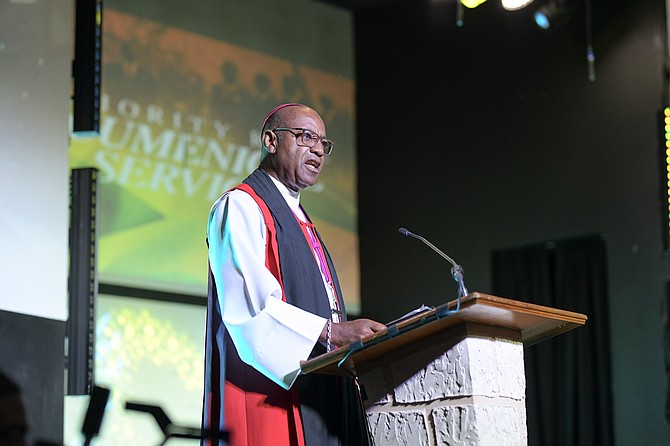
ANGLICAN Bishop Laish Boyd.
By LYNAIRE MUNNINGS
Tribune Staff Reporter
lmunnings@tribunemedia.net
ANGLICAN Bishop Laish Boyd has delivered a scathing assessment of political campaigning, warning that rallies are more about spectacle, ridicule and crowd manipulation than serious national discussion as the country heads to the May 12 general election.
In a pastoral letter to the Anglican community, Bishop Boyd criticised the performative nature of rallies, arguing that entertainment and personal attacks are crowding out meaningful debate on issues that affect the country.
“In campaigning and in rallies, deal more with issues and not people, personalities, mistakes or misfortunes,” he said. “Campaign rhetoric and rallies focus too often on making fun of others, slurring, tearing them down and belittling them. Rallies are sometimes a show designed to make people laugh and to entertain, as well as to whip the crowd into a frenzy, appealing to persons’ baser nature and instincts. But should we feed into this culture of entertainment? No, we should not!”
He said the problem is not isolated behaviour, but a wider political culture that rewards hype over substance and encourages supporters to engage at the lowest level of discourse.
“I am of the view that while many in the political realm love rallies and some feel they are indispensable, that they advance the party cause but do little to advance the country,” he wrote. “They certainly are not issue-oriented enough and do little to educate the electorate or deepen the political culture, much less advance any national development goal.”
In one of his most pointed observations, Bishop Boyd argued that political organisations and their supporters are complicit in sustaining this environment.
“Some will say, ‘Oh, you have to have rallies!” he said. “This is just the way it is! Okay, but I say that this is not how it needs to be; this is simply how we make it. And the crowd is not better than the political party organising the rally: each feeds off of and stokes and ingratiates themselves to the other. But is this right? Is this in the best interest of national well-being? One person once said to me, ‘Father, who cares about national development? We want to win. Too often, this is the goal at all costs. Too many of us think, feel and act this out in our political lives.”
Despite his criticism, Bishop Boyd stressed that politics and campaigning themselves are necessary and can serve a constructive purpose when done properly.
“The political party machinery and campaigning are important and vital because these are the means whereby parties move toward a desired result by the way of a national consensus,” he said.
“We know that it can be a dirty game and some underhanded, scandalous things can happen in pursuit of a particular goal, but it is not an inherently dirty process in itself: this is only what some participants make it.”
He argued that the absence of principled people from the political space only worsens the problem, calling for greater involvement from those with strong moral grounding.
“Good people and Christian people need to be involved to influence the process and to help it to be its best rather than its worst,” he said.
At the same time, the bishop warned that entering politics is not enough, noting that people of good character can still lose their way once exposed to pressure, ambition or party loyalty. He stressed that maintaining integrity requires consistency, discipline and a refusal to compromise core values, describing the kind of quiet but firm influence needed to elevate public life.
Beyond critique, Bishop Boyd framed civic participation as both a national and spiritual responsibility, urging citizens to remain engaged and grounded during the election period.
“I call on all citizens, residents, and friends of the Commonwealth of The Bahamas – especially you, my Anglican Family – to pray for the leaders and members of the political parties, for the nation and for the entire general election activity,” his letter read.
“We are called to ‘pray without ceasing’ (1 Thessalonians 5:17). Why pray? Because prayer influences and changes people and things, and because when we pray earnestly, prayer changes us and strengthens us, even if circumstances around us do not change as quickly as we might like them to.”
He also underscored that political engagement is not optional for people of faith, but a necessary part of shaping a better society.
“If good, upright, honourable Christian people do not get involved, how will the exercise be elevated?” he wrote. “Too many people of good character and sound morals stay out of campaigning and front-line politics, but we need them there.”
Bishop Boyd closed by calling for a shift in tone and priorities, urging voters and political actors alike to move beyond winning at all costs and instead focus on the long-term health of the country.




Comments
bahamianson 4 months ago
Bulla, unless you are voting for a national lottery , shut your mouth.
screwedbahamian 4 months ago
Absolutely, Rise up Bahamians and get what rightfully belong to ALL Bahamians and not just a chosen Corrupt few. Lets stop paying 15-20% to The Number Houses enterprises in the many PPP for loans on our own money. They doing it through the many foundations and the undisclosed PPP, a double whammy! Lets start to stop paying high compounded interest and selling our national assets to the Numbers houses enterprises and foreign countries and fund instead with income revenue from a National Lottery!
licks2 4 months ago
Hiding ya head in ignorance is not the answer to anything!!! Make some sense and then I will come back to dialogue with this post. . .I een gat time for dumb stuff chile!!
screwedbahamian 4 months ago
Just another perfect example why we need the income and revenue from a National lottery to fund and improve our "D" average education.
Sign in to comment
OpenID