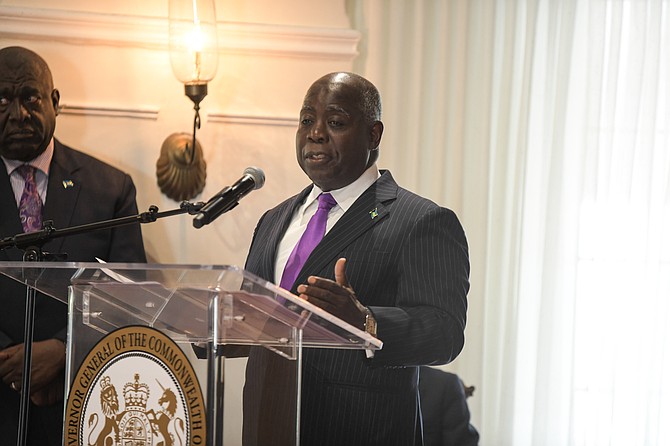
Prime Minister Philip "Brave" Davis
BY FAY SIMMONS
TRIBUNE Business Reporter
jsimmons@tribuneemedia.net
PRIME Minister Philip Davis said a fuel hedge covering 2.5m barrels will continue to shield Bahamian consumers from global oil price shocks through December, as the government works to reduce BPL’s exposure to volatile fuel costs through cheaper LNG and permanent generation.
Speaking during a National Address last night, Mr Davis said the hedge, executed in December, provided a full year of protection against movements in global fuel prices and meant geopolitical disruptions should not affect electricity bills in the same way they otherwise could have.
“We executed a fuel hedge in December, two and a half million barrels, a full year of protection, so a war on the other side of the world does not impact your light bill the way it would have if we had not executed the hedge,” he said.
Mr Davis said the government was also pursuing longer-term measures aimed at lowering the cost of generating electricity rather than relying solely on protection from movements in international fuel prices.
He pointed to the government’s shift away from rented generation, saying 40MW of rental generation will begin being phased out in January as permanent capacity comes online.
The move is part of an effort to reduce a major recurring cost at Bahamas Power and Light, which Mr Davis said had been spending more than $40m a year to rent engines when he first outlined the state of the electricity system.
“Renting. Money out the door, and not one dollar of it buying an asset we would own at the end,” said Mr Davis.
He said BPL was restoring permanent generation capacity, with Blue Hills GT2 expected to return to service, the battery storage system that helps shave the evening peak also returning, and two Clifton Pier engines scheduled to be back before the end of September.
“The Blue Hills turbine under major inspection returns in the first quarter of next year,” said Mr Davis.
The government is also looking to change BPL’s fuel mix, with the first phase of liquefied natural gas coming online this year and gas-fired capacity expected to scale to 190MW by late 2027.
New pipelines will replace a pipeline more than 40 years old, while combined-cycle plants at Blue Hills are expected to be commissioned during 2027 and 2028.
Mr Davis said the shift to LNG would significantly reduce the cost of producing electricity.
“We will be able to produce power at a fraction of today’s fuel cost,” he said.
He also pointed to savings already delivered to consumers through the Equity Rate Adjustment, which he said saved consumers $11.5m last year.
“One in five residential customers paid no base rate charge at all,” said Mr Davis.
The measures form part of the government’s broader effort to move BPL away from short-term measures to keep the system operating and toward permanent generation, fuel diversification and improved financial management.
Mr Davis said BPL must continue completing critical overhauls, maintain its assets based on reliable data and integrate and expand battery storage, while rental generation should only be phased out once replacement capacity has been tested and is ready.
He said the government’s energy reforms were also being recognised by international credit rating agencies, with Moody’s upgrading the country’s credit outlook twice within a year after nearly two decades without such an improvement and citing energy reform as one of the factors.
The fuel hedge provides protection through the end of this year, but the government’s longer-term strategy is aimed at reducing the extent to which BPL’s costs and consumers’ bills are exposed to international fuel markets once that protection expires.
Mr Davis said the goal was to move from a system that spends to survive the next emergency toward one that invests in infrastructure and generation capable of reducing future costs.




Comments
Use the comment form below to begin a discussion about this content.
Sign in to comment
OpenID