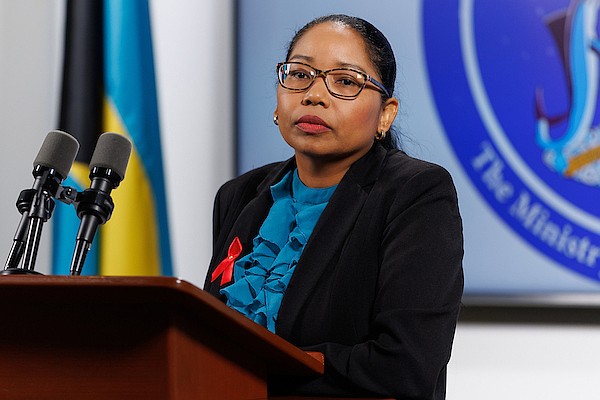
Director of the National HIV/AIDS and Infectious Disease Programme at the Bahamas Ministry of Health Dr Nikkiah Forbes speaks during a press briefing on the status of HIV and other sexually transmitted infections in The Bahamas at the Office of The Prime Minister on July 17, 2025. Photo: Dante Carrer/Tribune Staff
By EARYEL BOWLEG
Tribune Staff Reporter
ebowleg@tribunemedia.net
ONE hundred and forty two newly reported HIV cases were recorded in The Bahamas in 2025, with men accounting for more than 60 percent of cases and people aged 30 to 39 representing the largest affected group, according to National HIV/AIDS and Infectious Diseases Programme Director Dr Nikia Forbes.
Dr Forbes said health officials are studying why men and people in that age group represented the largest share of newly reported cases, noting that the trend could reflect differences in health-seeking behaviour, delayed testing or risk behaviour.
The Bahamas recorded 156 newly diagnosed HIV cases in 2024, up from 130 in 2023.
Dr Forbes spoke on Friday during the Ministry of Health and Wellness’ annual Regional Testing Day event at RM Bailey Park, where officials offered free HIV and sexually transmitted infection testing, counselling and prevention information.
“We have 144 cases, 142 cases that were reported in 2025 and so we've been looking at trends of the newly reported cases from since the beginning of the epidemic, basically,” she said.
She noted that new HIV infections have fallen sharply since the height of the epidemic, when The Bahamas recorded hundreds of newly reported cases in some years.
“The UN, they are looking at the 2010 year as the benchmark for the metric to reduce new HIV infections by 75 percent by the year 2030,” she said. “So in those years, in the 1990s, sometimes we had as high as almost 800 newly reported infections. In 1993 that was a whole lot. So, 142 is definitely down from that but one case is too many.”
Dr Forbes said HIV experts and other partners are examining the reasons behind the demographics of newly reported cases.
“We're needing to look a little closer at that, but it could be health-seeking behaviour,” she said “Women tend to maybe access healthcare more for checkups with no symptoms.”
“We’re wondering now if this is a catch-up trend where men maybe previously they were not getting their checkups regularly, but they could be presenting with symptoms now.”
“Like maybe they had the infection for a while, but now they're presenting with symptoms for testing, and then we have to look at risk behaviour. We are not certain as to why that is, but we are taking a closer look at it.”
Local officials completed The Bahamas’ UNAIDS report in the spring and are awaiting its release.
Dr Forbes said 96 percent of people living with HIV in The Bahamas know their status. She said 81 percent of diagnosed people are receiving treatment, while 98 percent of those on medication have achieved an undetectable viral load, which she described as the gold standard of HIV care.
This year’s Regional Testing Day event expanded to include screenings for chronic non-communicable diseases through a partnership with other Ministry of Health units.
Officials also demonstrated HIV self-testing, an oral swab test that can be done at home.
Last year, 347 people were tested in activities leading up to Regional Testing Day.




Comments
Use the comment form below to begin a discussion about this content.
Sign in to comment
OpenID