By ANNELIA NIXON
Tribune Business Reporter
anixon@tribunemedia.net
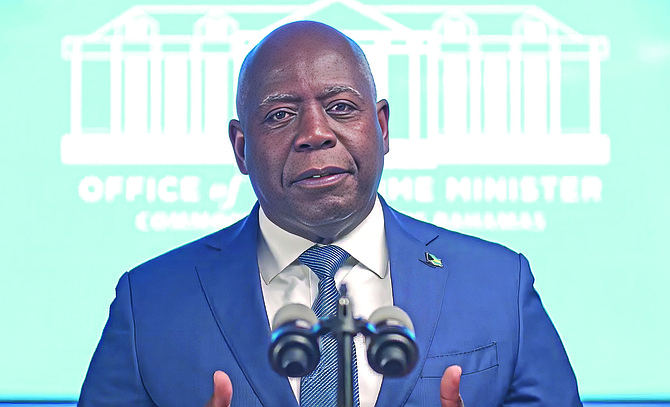
THE Prime Minister yesterday argued that small states such as The Bahamas must have a say in developing digital economy policies particularly when their sovereignty - data, infrastructure and markets - is used.
Philip Davis KC, speaking at the opening of the International Telecommunication Union’s World Telecommunication/ICT Policy Forum (WTPF) being hosted in Nassau, defined what he called a “sovereignty discount” as the cost countries pay when negotiating from a position where they have limited alternatives.
He added that this cost can be reflected in the price of communications capacity, the length of service outages, contracts offered on take-it-or-leave-it terms and technical standards developed without the participation of smaller states.
“It is not charged once,” Mr Davis said. “It compounds and it is invisible in the statistics we celebrate. A country can be counted as connected and still be paying for it every day.”
He argued that resilience cannot be left solely to commercial considerations, particularly for island economies where a single point of failure can disconnect entire communities, and pointed to the disparity in digitally deliverable services exports. The Prime Minister said such services account for more than 60 percent of services exports in advanced economies compared with 15 percent in lesser developed countries.
Mr Davis rejected the idea that smaller countries should simply accept technological and regulatory developments as inevitable. “Inevitability is not a description of the future,” he said. “It is a demand about the present. It asks you to stop negotiating. It asks you to accept today what has not yet happened. It asks you to treat another party’s preference as your destiny.”
He argued that decisions surrounding spectrum allocation, satellite orbital co-ordination, landing rights, licensing conditions, technical standards and taxation all have identifiable decision-makers and can therefore be changed.
“Sovereignty is very rarely taken from a nation,” he said. “It is conceded, one reasonable concession at a time.” Rather than resisting investment or technology, Mr Davis said The Bahamas wants greater control over the terms governing digital infrastructure.
“We are not hostile to investment. We are open, and we intend to stay open. Many of you in this room are our partners,” he added. “Interoperability is a technical standard. Sovereignty is a legal capacity. A country can hold both. And only countries that hold both can be relied upon to keep this network open when it is tested.”
Mr Davis said SIDS such as The Bahamas could develop a common position ahead of the ITU Plenipotentiary Conference in Doha in November, listing data, control of digital infrastructure, resilience, space and national capability as key issues.
He called for personal data to be treated as a protected national interest, with cross-border transfers negotiated rather than assumed, and greater local economic value captured through processing, skills and revenue.
On infrastructure, Mr Davis said governments do not necessarily need to own cables to exercise control over them, but should have enforceable landing rights, open-access obligations and strong licensing conditions.
He called for communications to be treated as critical national infrastructure, with redundancy and restoration requirements reflecting the particular vulnerabilities of island states.
On space connectivity, Mr Davis welcomed satellite technology as a means of overcoming geographical barriers but warned that it could also leave sovereign states dependent on individual companies.
Speaking on capability, he proposed the creation of a shared technical facility for SIDS to build expertise among regulators, engineers, teachers and negotiators.
Mr Davis also sought support for The Bahamas’ candidate, Stephen Bereaux, for the position of deputy secretary-general of the ITU. Mr Davis highlighted Mr Bereaux's more than 20 years of experience in telecommunications and his previous leadership of the Bahamas' telecommunications regulator, arguing that his election would also represent an opportunity for greater representation of SIDS within the ITU's senior leadership.




Comments
Use the comment form below to begin a discussion about this content.
Sign in to comment
OpenID