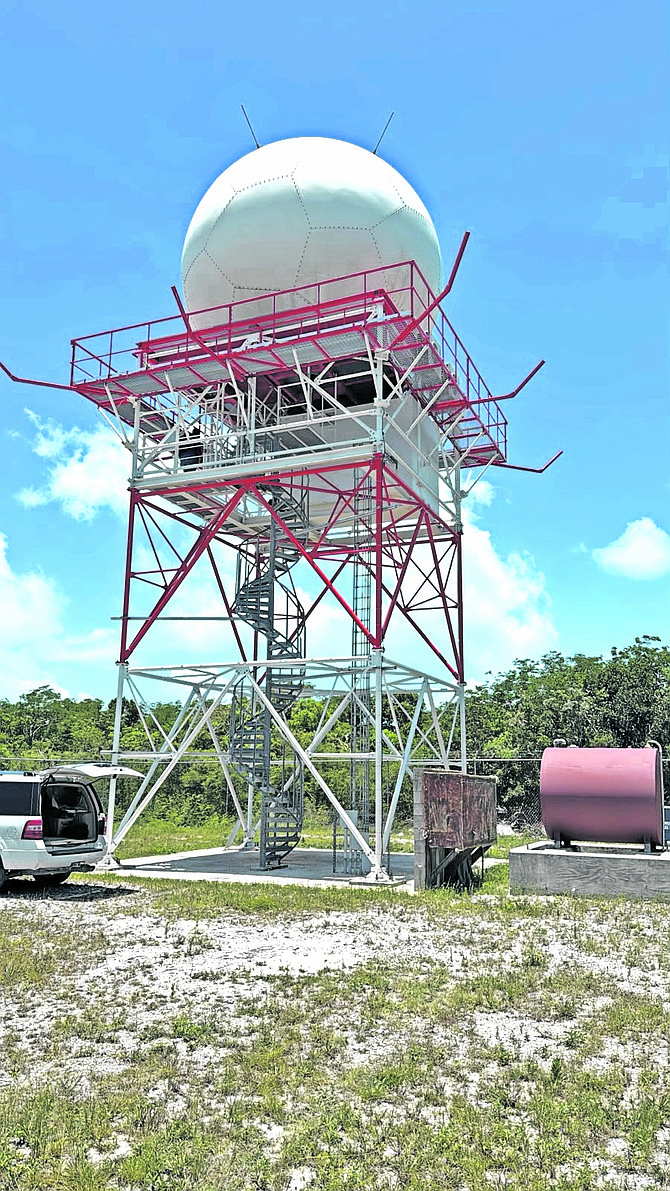
History was made in The Bahamas this week with all four of the country’s C-Band National Weather Radars operating simultaneously for the first time ever.
The milestone came after the Mayaguana radar was energised for the first time since it was installed in March 2021, creating a radar network spanning the Bahamian archipelago and extending towards the Turks and Caicos Islands.
Located in the southeast Bahamas, the Mayaguana radar is a particularly important component of the national network, and its activation by the Bahamas Aviation Climate & Severe Weather Network (BACSWN) unlocks the full potential of the four-radar system.
The achievement follows BACSWN’s signing of a $427 million Heads of Agreement with the Government on May 7, 2025, under which the company committed to significantly expand weather and radar surveillance across The Bahamas.
BACSWN president and chief executive Patrick Rollins thanked his team for its efforts and acknowledged the time, resources and technical assistance provided by Bahamas Power and Light (BPL).
The four C-Band radars, strategically located in New Providence, Abaco, Long Island and Mayaguana, were installed as part of an approximately $20 million weather radar modernisation project initiated by the Government and undertaken by Vaisala in 2017.
The next objective is to restore and integrate the EEC S-Band weather radar on Ragged Island. Once returned to service, it will further strengthen the national radar infrastructure and complement the four operational C-Band systems.
BACSWN COO Michael Strachan said the expanded network will allow forecasters to analyse radar observations alongside other meteorological data, providing a broader and more continuous picture of precipitation, thunderstorms and other significant weather as systems develop, move across the islands or approach the archipelago.
The timing is particularly significant with the Atlantic hurricane season underway. Enhanced radar coverage will improve the country’s ability to monitor tropical weather and severe thunderstorms, identify rapidly changing conditions and provide real-time information to support forecasting, warnings and emergency preparedness.
BACSWN said the radar network will form part of a broader weather and aviation surveillance system incorporating Raytheon’s multi-function phased-array radar technology, advanced electro-optical sensors and other systems.
The company is also collaborating with the US National Oceanic and Atmospheric Administration (NOAA) on the integration of the Advanced Weather Interactive Processing System (AWIPS), the operational forecasting and weather-data platform used by the US National Weather Service, NOAA and the National Hurricane Center.
AWIPS will allow BACSWN’s aviation meteorologists to combine radar observations with satellite imagery, surface observations, numerical weather prediction models, lightning data and other meteorological information within a single operational environment.
BACSWN said its ongoing development of its WxSenseNet™ system, partnership with Israeli satellite weather company Tomorrow.io, and collaborations with the National Center for Atmospheric Research (NCAR) and NOAA will further enhance the country’s weather-monitoring capabilities.
The benefits extend beyond hurricane preparedness. Improved radar coverage and integrated meteorological data are expected to provide greater situational awareness for aviation, marine operations, emergency management, government agencies, businesses and communities.
BACSWN said the achievement represents an important step towards strengthening The Bahamas’ national weather infrastructure and improving its ability to deliver timely weather intelligence, enhance aviation safety and prepare for hurricanes and other severe-weather events.
Itai Zlotnik, co-founder of Tomorrow.io, said: “We built Tomorrow.io to own the whole chain: satellites that sense the atmosphere, models that run on what they measure, and software that turns both into a decision.
“A national aviation weather centre used to take a decade of capital to build. The Bahamas is skipping that and building the first next-generation meteorological watch office from the ground up, for a strategically located nation encompassing 173,000 sq miles - 95 percent ocean.
“That only works with a partner as ambitious as the idea, and BACSWN is that partner. Working with them has been a privilege. They knew exactly what the country needed, held every partner at the table to a world-class standard, including us, and pushed us to be better.
“It is the kind of partnership we hope for on every programme and rarely get. In Nassau, their sensor network anchors the ground, our satellites observe the sky, and our models turn every observation into a decision: hold the approach, reopen the runway. Pilots, controllers and the communities they serve will have weather intelligence most of the world does not have yet.”




Comments
limeyconch 1 month, 2 weeks ago
Great news! If only we could access the images online, seems like the system is on one day and off the next, lets get our poo together and get us into the modern age
pileit 1 month, 2 weeks ago
An absolute farce. Shady backroom deals handing over government responsibility to layman profit driven private speculators. www.BACSWN.org. Keep deleting, I'll keep posting, y'all jig is up.
Sign in to comment
OpenID