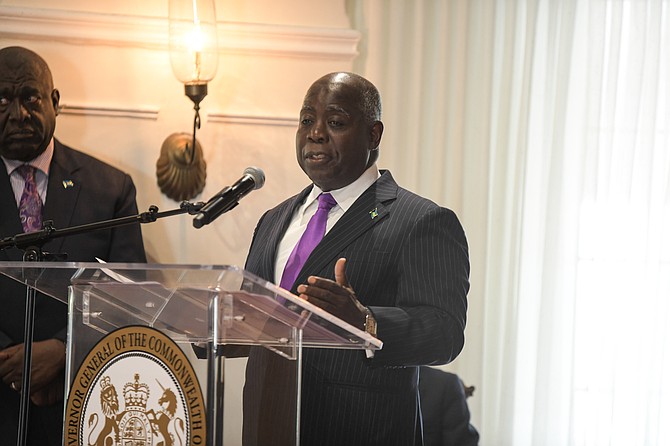
Prime Minister Philip "Brave" Davis
THE Bahamas has committed $25m to a national blue carbon programme that Prime Minister Philip Davis said is expected, once scientific work and government review are completed, to show the country removes more greenhouse gases than it emits within the scope of its national inventory.
Mr Davis made the announcement in New York yesterday as he formally presented The Bahamas Blue Carbon Programme, which aims to measure and protect the country’s vast seagrass resources and ultimately position The Bahamas to transfer internationally recognised emissions reductions under Article 6 of the Paris Agreement.
For the first time, he said, the government is incorporating the country’s seagrass biome into its assessment of national greenhouse gas emissions and removals as part of an updated Nationally Determined Contribution.
The work includes mapping, field verification, ground-truthing and sampling, which are being combined with an enhanced national greenhouse gas inventory.
Subject to completion, government review and technical validation, Mr Davis said the exercise will confirm that The Bahamas removes more greenhouse gases than it emits within the scope of that inventory.
“The country you were told is drowning may be helping the world to breathe,” he said.
However, Mr Davis stressed that the government is not yet announcing carbon credits or mitigation outcomes available for sale or transfer.
Instead, he said the government has enacted the necessary legislation, committed substantial resources and begun national-scale scientific work intended to establish the foundation for the programme.
The $25m committed by the government will fund the first phase, including the scientific baseline, seagrass mapping, fieldwork, carbon inventory and systems required for implementation.
Mr Davis said scientists and specialists in climate, oceans, data, economics, law, conservation and finance are involved, but their findings will not be released until the work has been completed, reviewed and technically validated.
“I will not trade our credibility for a headline,” he said.
The programme follows scientific work that used tiger sharks fitted with cameras and tracking devices to map previously undocumented expanses of seagrass across the Bahama Banks.
Mr Davis said researchers following the sharks discovered what he described as one of the largest seagrass ecosystems ever recorded.
He said those seagrass meadows store and sequester carbon, support biodiversity, fisheries and food security, protect coastlines and contribute to water quality and wider ocean health.
The government now plans to use that resource as part of a broader strategy linking environmental protection, climate finance, national resilience and sustainable development.
Mr Davis said potential interventions under the programme include seagrass conservation and restoration, sustainable fisheries, maritime zoning, marine protection, improved water quality, pollution control, coastal resilience and community-based conservation.
An econometric model has also been commissioned to assess proposed interventions and direct investment towards those expected to produce the strongest environmental and development results.
The programme is also intended to move The Bahamas towards authorising and eventually transferring internationally transferred mitigation outcomes, known as ITMOs, under Article 6 of the Paris Agreement.
Mr Davis said Bahamian ITMOs are expected to become available only after the necessary scientific, technical and sovereign authorisation requirements have been met.
He said each mitigation outcome would have to be measured and verified, transparently accounted for and protected against double counting.
“We will not move ahead of the science,” Mr Davis said, “and we will not compromise environmental or regulatory integrity.”
The government laid the legislative groundwork in 2022 with the Carbon Credit Trading Act and Climate Change and Carbon Market Initiatives Act.
Mr Davis said the laws allow The Bahamas to govern its carbon assets, participate in international carbon markets, protect its marine interests and cooperate with other countries under Article 6.
He emphasised that the marine resources involved would remain under Bahamian control.
“Hear me on sovereignty,” Mr Davis said. “What lies beneath Bahamian waters belongs to the Bahamian people, and it will remain under sovereign and regulated national control.”
He said Article 6 cooperation would be based on credible governance, accounting safeguards and protection against double counting, with benefits serving the long-term interests of the country and its people.
Mr Davis also called on foreign governments to begin substantive Article 6 discussions with The Bahamas and invited investors and development partners to provide capital, scientific and technical cooperation, capacity-building and long-term investment.
He said the programme is also intended to develop Bahamian expertise in marine science, environmental studies, data science and related fields so Bahamians can eventually lead the management of the resources.
Mr Davis framed the programme as an attempt to change the international portrayal of The Bahamas and other small island states primarily as victims of climate change.
The Bahamas contributes only a small share of global greenhouse gas emissions, he said, while its communities, coastlines, fisheries, tourism industry, public finances and infrastructure face significant climate pressures.
“Today, with the full voice of my country behind me, I tell you that role is finished,” Mr Davis said. “We will no longer be victims in our own story.”
He said the blue carbon programme would instead seek to quantify what the country’s marine ecosystems contribute to the global climate system.
“For a generation, the world has looked at small islands and seen the first to fall,” Mr Davis said. “Look again. We may be the first to lead.”




Comments
Use the comment form below to begin a discussion about this content.
Sign in to comment
OpenID