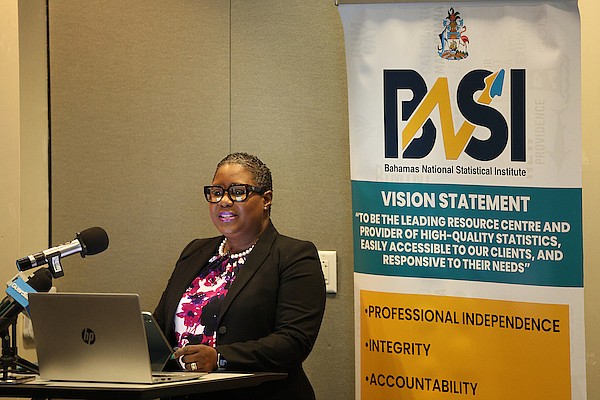
National Insurance Board (NIB) deputy director and Bahamas National Statistical Institute (BNSI) board member Dr Tami Francis speaks during the presentation of the 2022 Census of Population and Housing at the University of The Bahamas yesterday. Photo: Dante Carrer/Tribune Staff
By LYNAIRE MUNNINGS
Tribune Staff Reporter
lmunnings@tribunemedia.net
WORKERS earning more than $810 a week will pay about $4 more per month in National Insurance contributions from July 1, while pensioners will receive a monthly increase as the National Insurance Board rolls out its latest statutory biennial adjustments.
The changes, announced yesterday by NIB Director Dr Tami Francis, include a 1.5 percent increase in pensions and grants and an increase in the insurable wage ceiling from $810 to $830 per week.
The adjustments fall under the National Insurance Act framework governing mandatory biennial reviews, a system designed to keep benefits and contribution thresholds aligned with inflation and wage growth.
A pensioner receiving the minimum retirement pension of about $364 per month will now receive about $369.46. Workers earning more than $810 per week will pay contributions on an additional $20 of weekly earnings when the new ceiling takes effect.
Dr Francis said the changes are required under a statutory biennial review process introduced through amendments to the National Insurance Act in 2010. The amendments replaced the previous system, under which changes required separate legislative approval.
“In July 2010 the National Insurance legislation was amended to establish a statutory biennial adjustment process for pensions, grants, and the insurable wage ceiling,” she said.
“Prior to that amendment changes of this nature required separate legislative action. The amendment created a structured framework that allows these reviews and adjustments to occur every two years, ensuring that benefits and contribution thresholds remain responsive to economic conditions and changes in the cost of living.”
She said the adjustments are based mainly on movements in the Retail Price Index, which tracks changes in the cost of a basket of goods and services commonly bought by households.
“Think about the cost of living today compared to where it was two years ago. Of course, our grocery bills are higher; many household expenses cost more than they did just a few years ago,” Dr Francis said.
“The retail price index measures those changes across a basket of goods and services that people purchase every day. The law requires NIB to review those changes every two years and to determine the rate at which pensions and grants should be adjusted.”
Dr Francis stressed that the increases are not discretionary, but are legally required under the Act to help prevent benefits from losing value as inflation rises.
She confirmed that all pensions and grants will increase by 1.5 percent, although the amount received will vary depending on when the benefit was awarded.
“As a result of this review of that review, which considered changes in the RPI over the review period, pensions and grants will increase by one and a half percent, while the insurable wage ceiling will increase by $20 per week to ensure coverage aligns with earnings growth,” she said.
“Therefore, the weekly insurable wage ceiling will increase from $810 to $830. The monthly insurable wage ceiling will increase from $3,510 to $3,597. All minimum pension rates and grants will increase by one and a half per cent. All pensions currently in payment before July 2026 will increase by up to one and a half per cent. The maternity grant will increase from $560 to $570, and lastly, the funeral benefit will increase from $2,060 to $2,100 for pensioners.”
She added: “These adjustments provide important protection against rising living costs. A pensioner receiving the minimum retirement pension of approximately $364 per month will receive an increase of approximately $5.46 per month. Now, while this increase may appear modest, it reflects an important principle: pension benefits should not be frozen while the cost of living continues to change.”
Pensioners who began receiving benefits before July 2024 will receive the full 1.5 percent adjustment. Those who started receiving pensions after that date will receive smaller, phased increases based on how recently they entered the system.
The insurable wage ceiling determines the maximum level of earnings used to calculate National Insurance contributions.
Dr Francis said the increase will affect only workers earning more than $810 per week, while those at or below the threshold will see no change in deductions.
“The insurable wage ceiling is the maximum weekly earnings that NIB uses rather to calculate its contribution payments. Many people assume that every worker will be paying more into national insurance, but that is not the case,” she said.
“The increase only affects contributors whose weekly earnings exceed the current insurable wage ceiling of $810. If you earn $810 per week or less, there will be no change to your national insurance deductions. For contributors earning above $810 per week, the new ceiling of $830 means that contributions will now be calculated, of course, on the additional $20 of weekly earnings.”
For affected workers, the increase amounts to about 93 cents more per week for employees, or roughly $4 per month. Employers will pay about $1.33 more per week, or about $5.76 per month, for each affected employee. Self-employed contributors will pay about $2.06 more per week, or $8.93 per month.




Comments
Use the comment form below to begin a discussion about this content.
Sign in to comment
OpenID