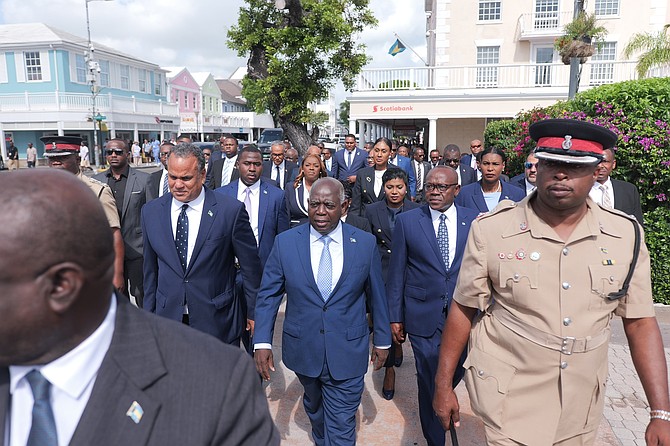
The Davis administration walks to the House of Assembly for the 2026 Budget Communication on May 27, 2026. Photo: Chappell Whyms Jr
By NEIL HARTNELL
Tribune Business Editor
nhartnell@tribunemedia.net
The Government is targeting a $470m revenue increase for the 2026-2027 fiscal period despite this year’s collection pace lagging 2024-2025, it was revealed yesterday, as it cut the forecast Budget surplus by 24 percent.
Michael Halkitis, newly-appointed minister of finance, in his first-ever Budget presentation told the House of Assembly that the lower surplus projected for the upcoming fiscal year - now $223.1m, as opposed to the previously forecast $291.4m, representing a reduction of $68.3m - was justified by the Davis administration’s decision to “prioritise the needs of the Bahamian people” by investing in healthcare improvements.
Explaining that the downward revision was also made against the backdrop of the still-simmering Middle East conflict, which has rocked fuel and energy markets and sparked renewed global inflation and pricing pressures, the minister asserted that the reduced surplus and overall fiscal position “remains positive” as the $223.1m forecast - if achieved - will represent by how much the Government’s revenue income exceeds its spending.
And the second Davis administration, just weeks into its second term following May 12 general election success, is also sticking to its initial projection of a $75.5m fiscal surplus for the current 2025-2026 fiscal year, which is due to end on June 30, despite the persistence of a volatile global economic and trade environment that could impact both tourism demand and drive higher prices for Bahamian consumers.
Mr Halkitis, in his Budget communication, did not give a dollar figure for where the Government’s estimated 2025-2026 surplus will close. “The Government should be able to achieve its goal of a Budget surplus,” he said, basing this on continued spending restraint and discipline plus renewed optimism that the $130m in projected corporate income tax payments will be collected before the fiscal year closes at end-June.
The Government’s near-term fiscal projections show it expects total recurrent revenues to jump by $470m, or 12 percent, year-over-year for the 2026-2027 Budget period compared to 2025-2026’s projected $3.887bn. It is aiming to achieve this despite the revenue collection pace for the nine months to-end March 2026 lagging behind the same period in the prior year, with just 65.3 percent of the full-year target collected compared to 69.4 percent at the same stage of 2024-2025.
And the Davis administration is also forecasting revenues will increase by nearly half a billion dollars despite predicting that real economic growth will slow drastically from 6.5 percent in the present 2025-2026 fiscal period to 1.8 percent in 2026-2027 - a rate that will be maintained in the following fiscal year. The Bahamas’ consumption-based tax system means a growing economy is vital for expanding government revenues by the projected $470m, yet the Budget estimates appear to be going in the opposite direction.
The Budget’s gross domestic product (GDP) growth forecasts also appear to be at odds with the stronger-than-expected 3.8 percent estimate for 2025 that was released last week by the Bahamas National Statistical Institute (BNSI). However, the 2026-2027 Budget identifies several areas where the Government expects to generate significant revenue growth.
Chief among them is the Domestic Minimum Top-Up Tax (DMTT), or 15 percent corporate income tax that is now levied on Bahamas-based companies that are part of multinational groups generating more than 750m euros in annual turnover. The Government is forecasting that revenue from this source will near-triple from the $130m projected in the present 2025-2026 fiscal year to $350m - a 169 percent year-over-year jump.
The Fiscal Responsibility Council, the Bahamas’ top public finance watchdog, in its recently-published assessment of the 2025-2026 mid-year Budget had voiced doubts over whether the $130m in DMTT revenues for 2025-2026 would be collected before the fiscal year closed because the necessary collection mechanism, guidance notes and regulations had not been implemented.
However, Mr Halkitis yesterday not only voiced optimism that DMTT revenues will be received next month before 2025-2026 closes, but disclosed that the Government now anticipates a much expanded taxpayer base for a levy that was introduced to enable The Bahamas to comply with the G-20/OECD minimum global corporate tax initiative intended to prevent multinationals dodging due taxes by shifting profits to lower-tax jurisdictions where they were not earned.
“As we move toward the close of fiscal year 2025-20026, the full-year fiscal outlook will be shaped by several important developments across revenue, expenditure and financing activity,” the minister of finance explains.
“One of these developments relates to the Domestic Minimum Top-Up Tax Act, which is a tax measure designed to ensure that large multinational enterprise groups operating in The Bahamas are subject to a minimum effective tax rate of 15 percent.
“Revenue collections under the Domestic Minimum Top-Up Tax Act were budgeted at $130m, or 0.7 percent of GDP. This is a new revenue category for the Government, and the related collections are expected to be received in June of this fiscal year,” Mr Halkitis added.
“At the time of last year’s Budget preparation, the anticipated taxpayer base was expected to be fewer than five taxpayers. However, recent information indicates that the number of taxpayers could exceed this projection, and this would have a positive impact on the overall year-end fiscal position.”
Besides the likes of Atlantis and Baha Mar, which are owned by Brookfield Asset Management and Chow Tai Fook Enterprises (CTFE) respectively, other major hotel chains such as Sandals are also likely to be caught by the 15 percent corporate income tax on profits. The major Canadian banks - Royal Bank, Scotiabank and CIBC - have also made provisions to pay the DMTT.
However, other companies such as Commonwealth Brewery, the Kalik maker that is 75 percent majority-owned by Belgian brewing giant, Heineken, and the Bahamas Telecommunications Company (BTC), controlled by Liberty Latin America, will also likely fall into the DMTT net. Commonwealth Brewery recently obtained an extension for publication of its 2025 year-end financials so it could properly assess corporate income tax liabilities.
Hutchison Whampoa’s Freeport assets, such as the Freeport Container Port and Freeport Harbour Company, are also likely to be caught, while Tribune Business also previously reported that Shell’s Bahamian subsidiary has a $248m corporate income tax liability “accrued” on its books for 2024.
Besides, the $220m year-over-year increase in corporate income tax revenues, which would account for 46.8 percent of the $470m total jump that the Davis administration is projecting, it has also included in its revenue forecasts a $99.228m bill issued to the Grand Bahama Port Authority (GBPA) to cover public services provided in the Port area whose costs exceed tax revenues generated by the city (see other article on Page 1B).
The Government is also projecting that it will generate $24m from a new real property tax category for “foreign owner-occupied” property. Properties in this category will pay a 0.625 percent rate, Mr Halkitis announced yesterday, and face a 33 percent increase in the “cap” or maximum they are liable to pay from $150,000 to $200,000. The qualifying criteria is also being changed from spending a minimum 180 days in The Bahamas to the owner using this as their primary residence.
Finally, the Government is also forecasting that VAT revenues in 2026-2027 will increase by $110m year-over-year, rising from a forecast $1.525bn this fiscal year - a target which is on pace to be beaten - to $1.635bn in the upcoming Budget period. Much of the increase is forecast to be driven by VAT levied on property sales worth over $1m, which is predicted to rise by $67m from 2025-2026’s $170.472m to $237.366m.
“The 2026-2027 Budget estimate for total revenue amounts to $4.4bn or 23.6 percent of GDP,” Mr Halkitis reiterated. “Total expenditure is estimated to amount to $4.1bn or 22.4 percent of GDP. Of this, recurrent expenditure accounts for $3.7bn or 20.1 percent of GDP, and capital expenditure for $415.8m or 2.2 percent of GDP.
“The fiscal surplus is estimated at $223.1m or 1.2 percent of GDP, with the primary balance showing a surplus of 5.2 percent of GDP. Given this, the debt-to-GDP ratio has been projected at 59.9 percent of GDP at the end of fiscal year 2026-2027.
“While this surplus is lower than previously projected in the Fiscal Strategy Report 2025, the revision reflects a changing global and domestic environment. Ongoing tensions in the Middle East have increased uncertainty, particularly around energy and import costs,” the minister of finance added.
“At the same time, we have made the deliberate decision to strengthen our healthcare system, including increased support for the Public Hospitals Authority (PHA) and further investment in hospital services.
“These are necessary and responsible choices. Although they have narrowed the surplus, the fiscal position remains positive, underscoring this Government’s continued commitment to sound financial management while prioritising the needs of the Bahamian people.”




Comments
Sickened 34 minutes ago
Great picture. Looks like the police are finally locking them up. I guess the police investigation found dirt on all of them.
Sign in to comment
OpenID