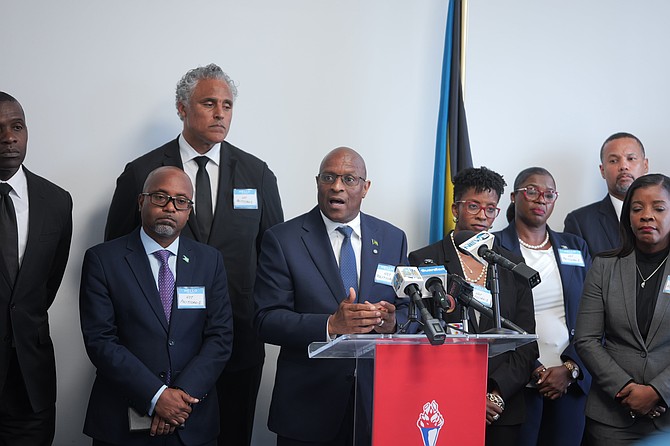
OPPOSITION Leader Michael Pintard responds to the 2026/2027 Budget Communication at a press conference on May 27, 2026. Photo Chappell Whyms Jr
By EARYEL BOWELG
Tribune Staff Reporter
ebowleg@tribunemedia.net
OPPOSITION Leader Michael Pintard yesterday demanded an accounting of how more than $200,000 in publicly funded gift certificates were allegedly distributed in Abaco during the general election, accusing the government of failing to address the controversy in its 2026/2027 Budget Communication.
Responding to the budget presentation, Mr Pintard said Finance Minister Michael Halkitis should have explained how the funds allegedly moved from the Ministry of Finance into vouchers bearing the names of Progressive Liberal Party candidates and officials.
“We would have expected that the Minister of Finance would make it clear in his initial statement how he went about, how they went about spending $200,000, having those funds leave the Ministry of Finance, and end up in Abaco in the form of vouchers, used to aid the political campaign in Abaco,” Mr Pintard said. “That appears very clearly to be an illegal act of misappropriation.”
“At a minimum, the Minister of Finance should have advised the country on the status of any investigation into how public monies were moved from the Treasury to advance a political campaign. Our minister of finance must give an accounting for that.”
The controversy centres on information that gift certificates worth more than $200,000 were distributed to Abaco residents in the names of PLP candidates and officials as Hurricane Dorian relief payments.
Chris Lleida, chief executive officer of Premier Importers, the company that issued the certificates, said the Ministry of Finance paid for the vouchers.
Mr Pintard’s call for answers formed part of a broader attack on the government’s budget presentation, which he rated at less than 50 out of 100. He argued that the administration failed to present measures that could meaningfully improve Bahamians’ lives.
He rejected government claims of progress in energy reform, the cost of living and housing affordability, arguing that Bahamians were not experiencing the improvements described by the administration.
Mr Pintard also challenged the government’s portrayal of improving public finances, accusing it of leaving major fiscal risks out of its budget narrative and failing to explain a substantial increase in public debt.
According to the Ministry of Finance, public sector debt stood at an estimated $14.1bn at the end of March 2026, up $689.2m from June 2025 and $57m from December 2025.
Mr Pintard said the increase required explanation because the government’s annual borrowing plan had indicated there would be no new borrowing. He questioned how debt could rise by nearly $700m without the government returning to Parliament for additional approval to borrow.
He accused the administration of repeatedly evading parliamentary scrutiny over the public purse and warned that the additional debt would persist beyond the current fiscal year.
Mr Pintard further argued that the government was shifting fiscal exposure into state-owned enterprises through loans, long-term contracts and financing arrangements that are not fully reflected in the budget figures presented to Parliament.
He pointed to Treasury lending to public authorities, claiming it increased from under $100m at the end of 2022 to more than $600m.
“In just over three years, more than a half a billion dollars have been advanced to state-owned entities, and all of those have been under the guise of loans,” he said. “We've not been told which budgetary appropriations these funds came from.”
“What was the legal authority that allowed the government to do this, and what are the terms of each of these loans, and how will these funds be repaid? This matters because the law is clear.”
“The government lending must come from properly appropriated funds approved by parliament. If these loans were not drawn from such appropriations. The government must explain what legal basis it relied on and what we realize over and over, their answer has been silence.”
Using Bahamas Power and Light as an example, Mr Pintard said tens of millions of dollars had allegedly been advanced from the Treasury to the utility without sufficient explanation to the public.
He said he had written to Prime Minister Philip Davis and raised questions in the House of Assembly about the movement of public funds, but had not received answers.
Mr Pintard also cited warnings from the Fiscal Responsibility Council about fiscal risks linked to state-owned enterprises, missing information and liabilities not properly reflected in the national accounts.
He accused the government of relying on unpaid bills to bolster its surplus figures and said large infrastructure projects were being structured to conceal their full costs.
Despite his criticism, Mr Pintard identified some housing measures in the budget as positive, including VAT reductions for first-time homeowners and multipurpose properties.
However, he questioned the government’s expenditure on Housing Project Renaissance through the Carmichael Village Project, saying current and former housing ministers had not explained how $40.2m of public funds was spent on the development.
He said the matter should be addressed during the budget debate and questioned whether the project had produced homes matching the value of the public money allocated to it.
Mr Pintard closed by rejecting the government’s economic assessment and insisting that public confidence depends on clear accounting for the use of public money.
“We do not believe that this budget speaks to the real issues Bahamians are dealing with,” he said. “Transparency is not optional. It’s the price for public trust.”




Comments
Use the comment form below to begin a discussion about this content.
Sign in to comment
OpenID