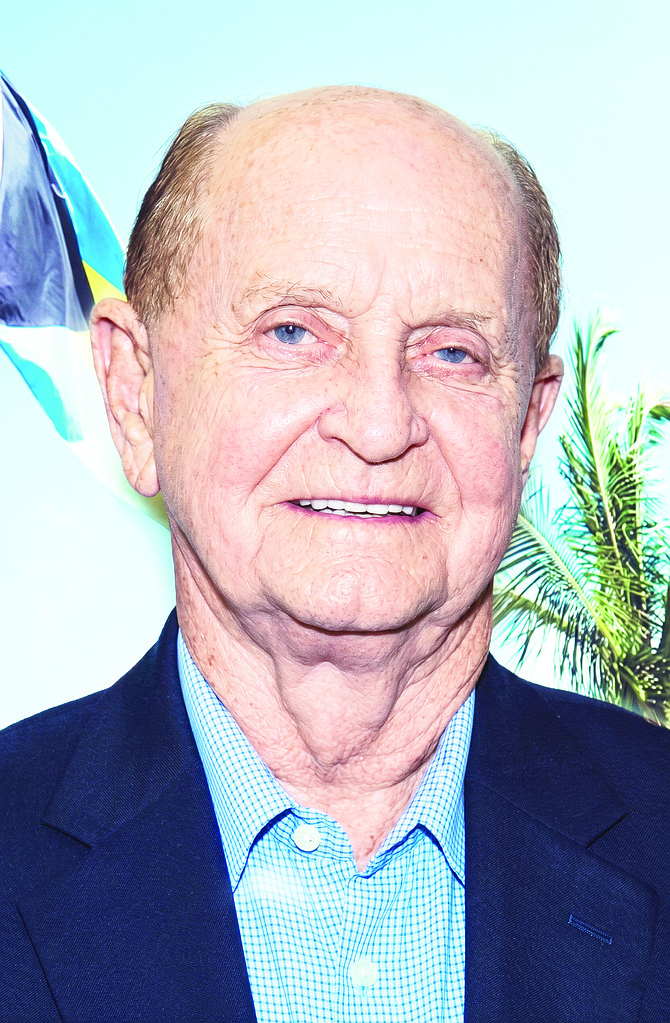
Rupert Roberts Jr
By LYNAIRE MUNNINGS
Tribune Staff Reporter
lmunnings@tribunemedia.net
BUSINESSMAN Rupert Roberts Jr, OBE, the grocery pioneer who built Super Value into the country’s largest Bahamian-owned supermarket chain and became a commanding voice in debates over food prices and the cost of living, died on Tuesday night on the eve of his 89th birthday.
Roberts died peacefully at the Mayo Clinic in Rochester, Minnesota, with wife, Margaret, daughter Candy and granddaughter Paige, at his bedside, according to a statement from Super Value.
He is survived by his wife; children Richard Roberts, Judy Waugh and Candy Kelly; several grandchildren and great-grandchildren; extended family members; and employees across the Super Value group.
Roberts launched Super Value in 1965 after rising through the ranks at City Markets, where he worked his way from supervisor to store manager at a time when the grocery sector was largely dominated by foreign-owned businesses.
What began as one store grew over several decades into a chain of 13 locations across New Providence. Super Value became a major outlet for Bahamian farmers and suppliers, while carrying international brands and locally produced goods. The company expanded in 2012 with the introduction of Quality Markets as a subsidiary brand.
Roberts also held business interests in real estate and commercial ventures, including South Bimini International Ltd, Bahamas Paper Converting, Discount Mart Limited and Global Bahamas Limited, while supporting charitable and community initiatives throughout his career.
His influence extended into banking. In 1984, after the Bahamianisation of Commonwealth Industrial Bank Limited, later known as Commonwealth Bank, Roberts was appointed the institution’s first chairman.
During his tenure, the bank’s total assets reportedly increased by more than 700 per cent to more than $125m, while net income rose from $1.3m in 1984 to $4m in 1992. He stepped down as chairman in 1988 but remained a director for 36 years.
In later years, Roberts was a prominent and often outspoken figure in national discussions over food pricing, inflation, import costs, taxation and supply chain pressure. His comments regularly placed him at the centre of debate as households struggled with rising grocery bills.
One of his final interviews with The Tribune came after a nine-week hospitalisation in the United States, where he had been airlifted for treatment. He expressed gratitude for the support and prayers he received from Bahamians and urged people not to neglect their health.
“Take care of your health,” he said.
“You could develop an illness that The Bahamas is not equipped to solve. A medical condition can develop into something more expensive than you can afford.”
Despite his illness, Mr Roberts remained determined to continue working.
“No, no…not at all! They advised me to keep going and never stop!” he said.
Tributes were delivered in the House of Assembly yesterday, with Prime Minister Philip “Brave” Davis recalling that he worked under Roberts at City Markets in the 1960s before Roberts emerged as a major business leader.
Mr Davis said Roberts was a significant figure in the country’s economic development and highlighted his philanthropy and support for communities across The Bahamas.
Opposition Leader Michael Pintard described Roberts as a staunch advocate for Bahamian agriculture and local production, citing his support for efforts to increase the presence of Bahamian-grown goods in supermarkets.
Mr Pintard also praised Roberts for maintaining an independent position on business and economic policy while engaging with both major political parties.
“I respected the fact that he did not allow politics to cloud his judgment in terms of what was in the best interest of the country, and so today I join thousands of Bahamians who mourn his passing and who thank God for the kind of life that he lived that contributed to so many persons' upliftment, and so may he rest in peace,” he said yesterday.
Don Williams, chairman of the Bahamas Chamber of Commerce and Employers Confederation, described Roberts as a leading private sector figure who contributed significantly to discussions on pricing, retail operations and business development.
Former Retail Grocers Association president Philip Beneby described him as a pioneer in the grocery sector who worked with industry stakeholders and supported the sector’s growth over many years.
The Organisation for Responsible Governance said Roberts served on its board since its formation and played a key role in supporting its governance and sustainability initiatives.




Comments
Use the comment form below to begin a discussion about this content.
Sign in to comment
OpenID